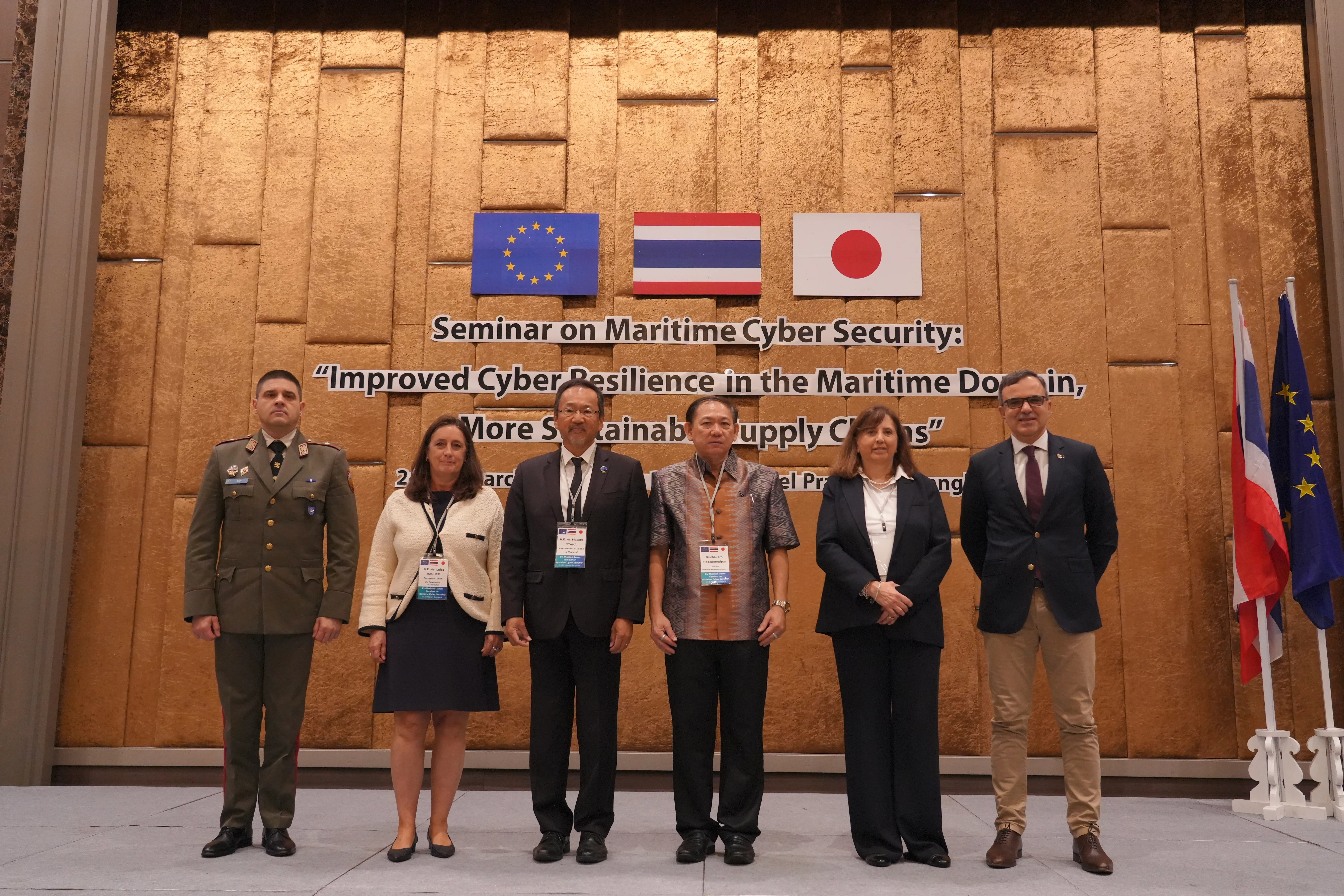
On March 25, 2026, experts in maritime and cybersecurity convened in Bangkok to discuss enhancing the cyber resilience of maritime supply chains. This two-day seminar brought together around 140 participants from the European Union (EU), Thailand, Japan, and various Southeast Asian nations, including Indonesia, Malaysia, the Philippines, Singapore, and Vietnam. It was co-organized by the EU, Thailand’s National Security Council, and Japan, with support from several organizations, including the Port Authority of Thailand and the Maritime Cybersecurity Centre of Excellence from Romania.
The event highlighted the importance of securing the maritime ecosystem—comprising harbors, ships, ports, and navigation systems—vital for global trade and communication. Participants reviewed the escalating cyber threats affecting maritime infrastructure and commercial vessels, emphasizing the necessity for collective efforts to mitigate these risks.
According to Ms. Paola Pampaloni, Deputy Managing Director for Asia and the Pacific at the European External Action Service, maritime cyber security has become strategically significant for the EU and its regional partners. She reiterated the need for a free and open Indo-Pacific as essential for global prosperity and stability. Through regional collaborations, such as those with Thailand and Japan, the EU aims to act as a reliable security partner, sharing best practices and experiences.
Mr. Ruchakorn Napapornpipat, Deputy Secretary-General of Thailand’s National Security Council, emphasized the ongoing partnership among Thailand, the EU, and Japan. He noted that the seminar built on the success of a prior discussion on the “Law of the Sea,” underscoring the growing importance of maritime cybersecurity in light of rapid technological advancements. Strengthening the capacities of Indo-Pacific nations to protect vital maritime infrastructure from cyber threats is deemed crucial for regional economic stability.
H.E. Otaka Masato, Japan’s Ambassador to Thailand, described Japan and the EU as strategic partners committed to upholding a rules-based international order. He highlighted the Japan-EU Security and Defence Partnership’s ambition to enhance cooperation in various security dimensions, including maritime security and combating hybrid threats.
The seminar aligned with ongoing EU initiatives supporting maritime security in the Indo-Pacific. The EU operates two naval missions aimed at securing critical sea lanes, and projects like CRIMARIO II and ESIWA+ bolster collaboration in maritime safety. On cybersecurity, the EU facilitates cooperation through initiatives aimed at building resilience and safeguarding critical infrastructure.
The ESIWA+ project plays a key role in the EU’s security and defense cooperation with the Indo-Pacific, focusing on thematic areas such as cyber and maritime security. It is co-funded by the European Commission and also supported by the German and French foreign affairs ministries.
In summary, the seminar in Bangkok served as a platform for leveraging collective expertise and fostering deeper partnerships among nations to enhance cybersecurity in the maritime domain, which is increasingly challenged by evolving threats.