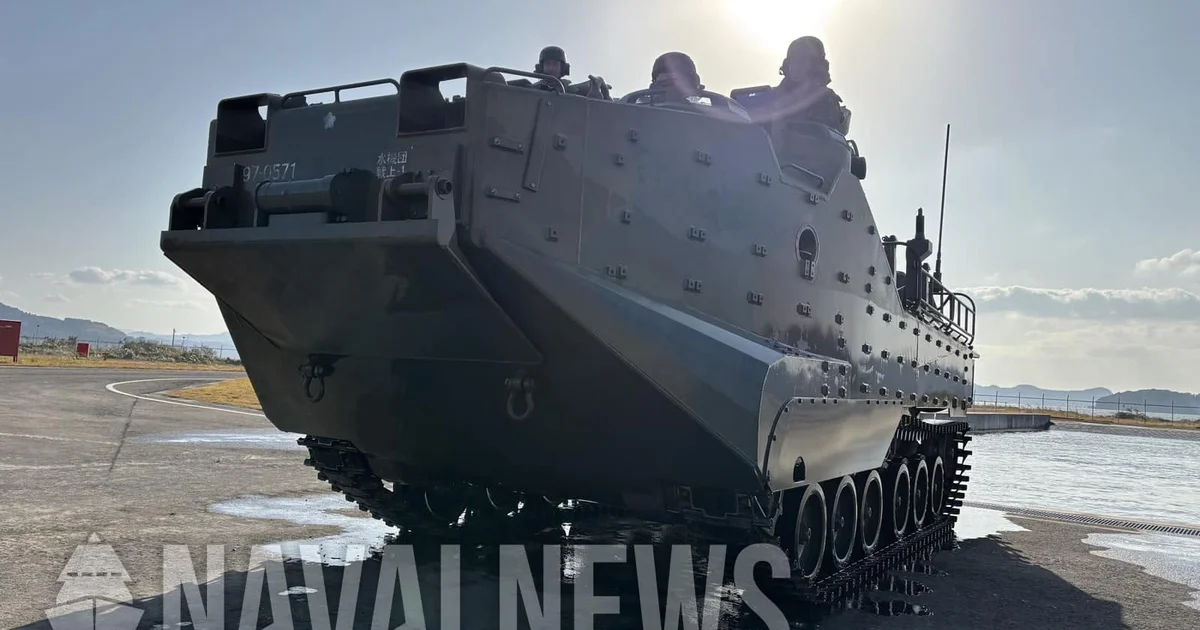
Japan’s Amphibious Rapid Deployment Brigade (ARDB), a division of the Japan Ground Self-Defense Force (JGSDF), has been tasked with bolstering the nation’s defense capabilities against potential maritime threats, particularly in the East China Sea’s Nansei Islands. Established in March 2018, the brigade represents Japan’s first dedicated amphibious force and consists of approximately 3,000 personnel based at Ainoura Garrison near Sasebo Naval Base in Nagasaki Prefecture. Positioned strategically for rapid mobilisation, the ARDB plays a central role in countering invasions on remote islands and conducting shore assaults. Its operational backbone lies in the deployment of AAV-7 amphibious assault vehicles, launched from the Japan Maritime Self-Defense Force (JMSDF) Ōsumi-class landing ship tanks.
Within the ARDB’s structure, the Combat Landing Battalion is key to amphibious operations. This battalion includes three Combat Landing Companies, all of which operate variants of the AAV-7, such as personnel carriers, command units, and recovery vehicles. Lieutenant Colonel Seiichirō Satō, battalion commander, provided insight into the operational challenges posed by the AAV-7 during an exclusive interview. According to Lt. Col. Satō, transitioning JGSDF personnel from traditional tank operations to amphibious roles has required substantial adaptation. Unlike conventional armored vehicles focused purely on combat, the AAV-7 is designed to balance troop transport and obstacle-clearing on beaches with combat functionality. This intermodal flexibility makes the vehicle integral to shore landings.
Training for amphibious operations within Japan poses unique logistical challenges. Lt. Col. Satō explained that the country lacks a consolidated training facility capable of integrating maritime maneuvers, shore assaults, and inland combat exercises. As a result, these components must be practiced independently, complicating troop readiness and coordinated assault proficiency. Additionally, the current AAV-7 fleet demonstrates operational limitations in areas such as firepower, maritime stability, and speed. At sea, severe pitching and rolling exacerbate motion sickness among personnel, while the vehicles’ slow waterborne speeds hinder rapid landing operations. Efforts to address these shortcomings are underway, with Mitsubishi Heavy Industries (MHI) developing a next-generation amphibious armored vehicle featuring improved firepower and stability.
The ARDB is also enhancing its deployment infrastructure. Construction on a new pier adjacent to Sakibe Vice-Camp has reached advanced stages, with the facility designed to enable direct loading of AAV-7s onto JMSDF landing vessels. This infrastructure upgrade is expected to expedite amphibious force mobilisation, offering greater responsiveness to maritime conflicts in the region. The ARDB's growing readiness aligns closely with Japan’s broader strategy to counter regional security pressures stemming from China’s expanding maritime presence.
Why this matters
The development of Japan’s ARDB underscores the increasing importance of specialised amphibious capabilities in modern maritime security. With tensions rising over strategically critical island chains and contested waters, the brigade equips Japan with a force capable of rapid deployment and island recapture. Shipowners and operators navigating the East China Sea may find that regional defence build-ups lead to stricter transit monitoring and heightened military activity around the Nansei Islands.
For the broader maritime industry, technical advancements in amphibious vehicles, such as those under development by MHI, signal emerging opportunities and demands within naval and cargo transport sectors. Enhanced pier facilities and vessel loading mechanisms at Sakibe Vice-Camp may also present logistics advantages during disaster relief scenarios or regional humanitarian operations.
The ARDB’s push for a unified training site highlights the challenges faced by military forces adapting to multi-domain amphibious operations, a factor with long-term implications for regional incident preparedness and inter-military cooperation frameworks. The maritime community operating near Japan should therefore anticipate expanded military exercises and readiness activities on key trade routes in the region.
As Japan progresses toward integrating advanced amphibious armor and pier-side deployment mechanisms, maritime operators should closely observe the ARDB’s developments, particularly for implications on regional vessel transit protocols and increased JMSDF presence near high-traffic areas. Further advancements in Japan’s amphibious capabilities could directly influence strategic shipping routes and security advisories across Asia-Pacific waters.