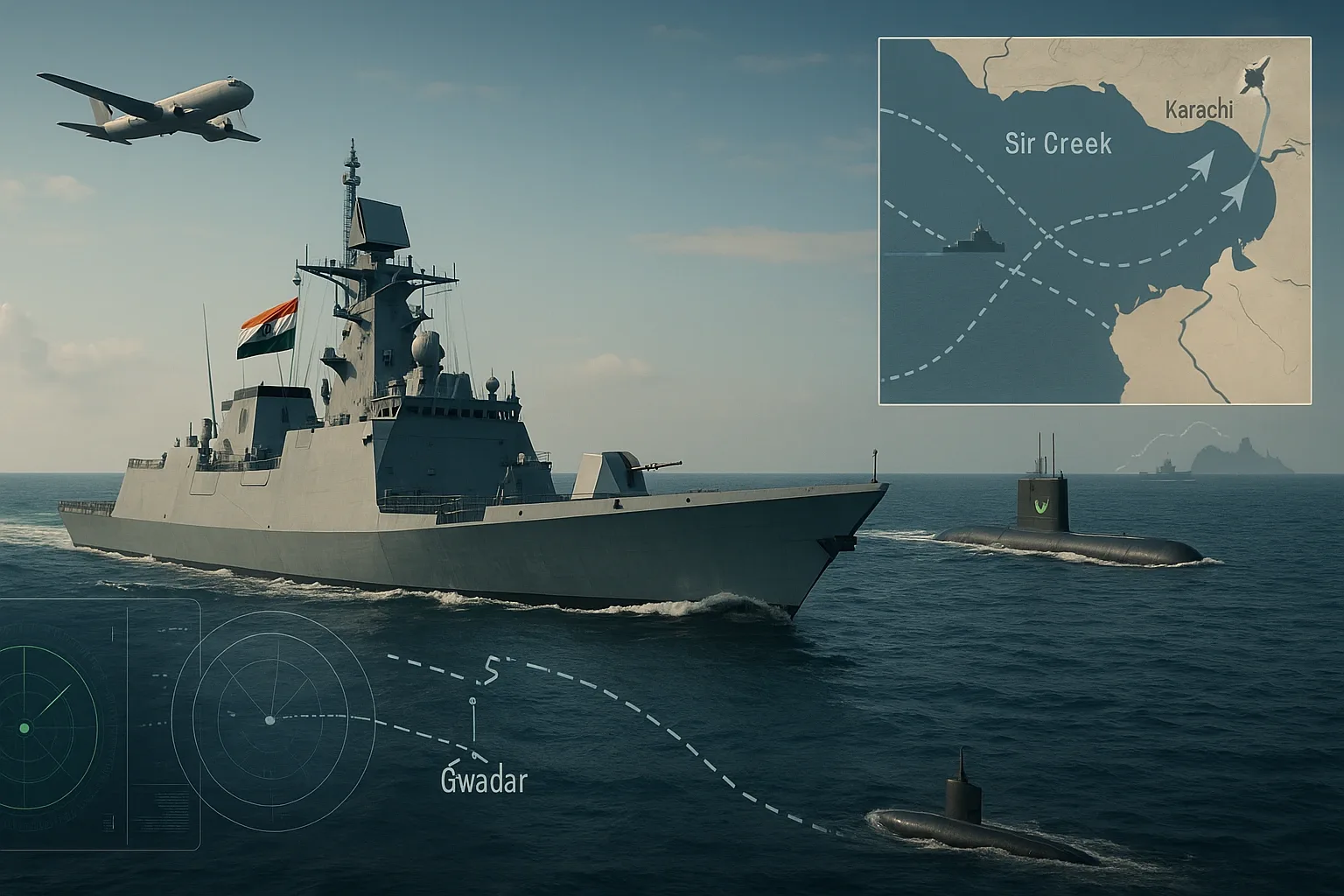
India and Pakistan are witnessing a pivotal transition in their strategic focus, with recent developments underscoring a shift from aerial confrontations to enhanced maritime posturing. The evolution of naval strategies became notably evident following the May 2025 standoff, which transitioned from an air-based engagement into a spotlight on naval theater dynamics. This shift is underscored by India’s Operation Sindoor, a proactive show of maritime deterrence.
India has ramped up its naval readiness amid tensions over the Sir Creek region, where Pakistan has been expanding military infrastructure. Indian Defence Minister Rajnath Singh issued a stern warning of significant repercussions for any military aggression, while Admiral Dinesh Tripathi revealed the Navy’s preparedness to act preemptively if required. Supporting this stance, India has strengthened its capabilities through developments such as the commissioning of the INS Nistar stealth frigate and joint naval exercises with the Philippines, aligning its strategy with the broader Indo-Pacific framework.
In response, Pakistan has advanced its maritime capabilities with key deployments, including the Hangor-class submarine PNS Mangro and the introduction of the P282 ship-launched missile. These advancements are backed by partnerships with China and Turkey, which have effectively narrowed India’s traditional naval superiority. Pakistan's strategic approach emphasizes deterrence-by-denial, leveraging assets such as Gwadar port that are central to both psychological and operational dimensions of the China-Pakistan Economic Corridor.
The shifting balance of naval power across both nations introduces a layer of complexity, as continuous maritime engagements carry higher escalation risks compared to transient aerial skirmishes. Chinese involvement at vital hubs such as Karachi and Gwadar ports, coupled with the possibility of People’s Liberation Army Navy (PLAN) activity, further heightens the geopolitical stakes in the region. Meanwhile, Turkey’s limited yet impactful engagement bolsters Pakistan’s regional foothold.
India’s modernized fleet, enhanced by indigenous stealth capabilities, confronts challenges in maintaining numerical superiority amidst Pakistan's burgeoning collaboration-driven advancements. Persistent naval presence and interaction, however, provide an avenue to convey intent while navigating risks of miscalculation inherent in outdated strategic assumptions.
Why this matters
The maritime rivalry between India and Pakistan has profound operational implications for regional stakeholders. Heightened naval capabilities on both sides transform the Indian Ocean into a contested strategic space, pressuring shipowners, operators, and port authorities to reassess security protocols and routing decisions in proximity to contested waters. Ports such as Gwadar and Mumbai may face indirect operational risks stemming from geopolitical tensions.
Global players investing in regional infrastructure—such as Chinese entities in Gwadar or Indian firms in Chennai—should anticipate greater scrutiny and potential delays impacted by maritime posturing. The broader Indo-Pacific trade corridor could witness shifts in vessel routing and insurance premiums as naval risks mount. Additionally, collaboration with external powers like the PLAN or Turkish military elevates maritime security concerns across chokepoints critical to global commerce.
India’s policy prioritizing indigenous fleet modernization signals opportunities for regional shipbuilders and component providers, yet also indicates potential procurement hurdles related to its aging fleet. Enhanced maritime signaling in contested zones could lead to escalated tensions, prompting operators to adopt advanced monitoring systems and align with risk mitigation strategies stipulated by flag state advisories.
Looking ahead, the Indian Ocean emerges as a critical arena for demonstrating naval resolve and intent. Maritime operators must strategically weigh the implications of heightened deployments, balancing commercial interests against the operational risks induced by geopolitical complexities. Monitoring developments in naval capabilities and observing regional maritime exercises will remain key as both nations redefine their strategic postures at sea.