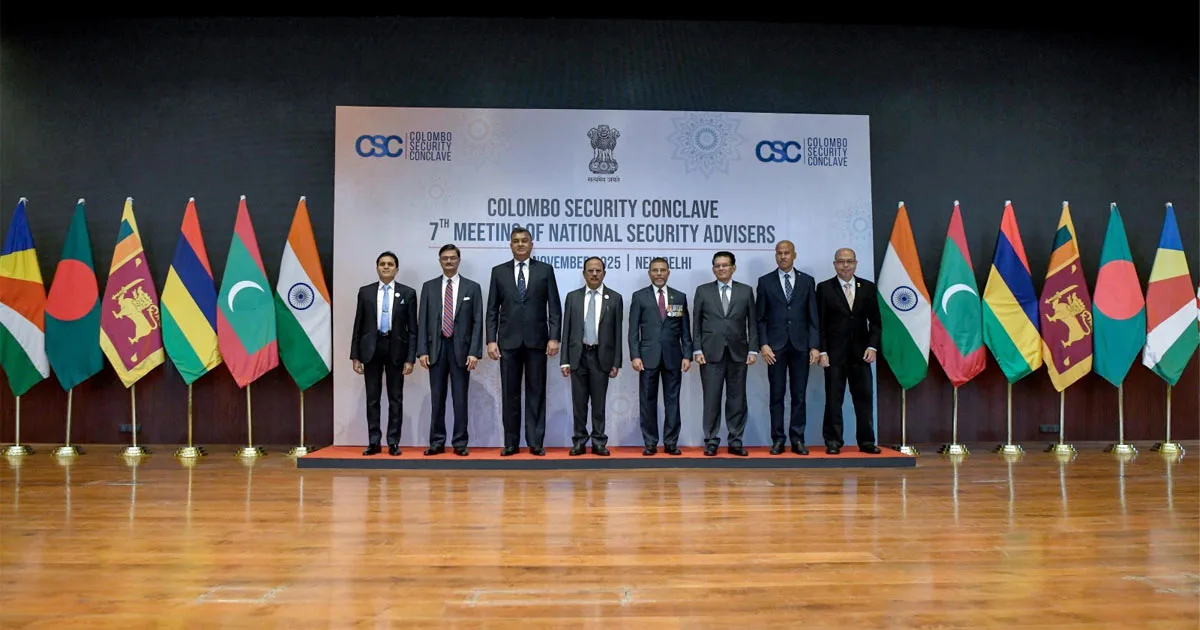
In November 2025, India hosted the 7th National Security Advisor-level summit of the Colombo Security Conclave (CSC), an initiative aimed at enhancing regional security cooperation in the Indian Ocean Region (IOR). Originally a trilateral partnership among India, Maldives, and Sri Lanka formed in 2011, the CSC re-emerged in 2020 after a period of stagnation due to political tensions. Its revitalization has underscored the need for collaboration amid ongoing regional challenges.
The Indian Ocean’s geopolitical landscape is currently marked by minimal cohesion among its countries, resulting in a strategic vacuum. Variable capabilities and differing threat perceptions hinder effective cooperation, further compounded by the vast geography of the ocean, which complicates collective security initiatives. The limited success of existing frameworks like the Indian Ocean Rim Association (IORA) and the Indian Ocean Naval Symposium (IONS) reflects these challenges.
In this context, the CSC represents a more focused mechanism for fostering cooperation among nations that share geographic proximity and common security concerns. Its expansion—to include Mauritius in 2022, Bangladesh in 2024, and Seychelles in 2025—demonstrates its growing significance. The CSC operates under five key pillars: Maritime Safety and Security, Countering Terrorism and Radicalisation, Combating Trafficking and Transnational Organised Crime, Cyber Security, and Humanitarian Assistance and Disaster Relief. This structured approach targets non-traditional security threats that align closely with the developmental priorities of its member states.
The CSC also promotes security as a mutual responsibility, helping members transition their focus from land-based issues to maritime security challenges. For smaller island nations like the Maldives and Seychelles, the initiative provides a platform to collaboratively address their primary security concerns while minimizing over-dependence on India. For India, the CSC enables recognition and response to evolving maritime threats, such as piracy, trafficking, and the growing presence of Chinese influence in the region.
Despite domestic political challenges, member countries have shown a commitment to the CSC. For instance, new governments in the Maldives and Bangladesh, despite initial absences from meetings, have later participated actively, indicating continued interest in regional security cooperation.
Through the CSC, India aims to secure its maritime interests while promoting defense cooperation and building capacity among neighboring states. The platform fosters a sense of regional responsibility as it addresses pressing non-traditional security issues. As the geopolitical dynamics of the IOR continue to shift, particularly with China’s increased engagement, the CSC emerges as a crucial forum for strengthening security cooperation and mitigating threats in this vital maritime region.
Overall, the CSC represents a responsive framework to contemporary challenges in the Indian Ocean, creating synergies to ensure collective security and stability among its members. This cooperative endeavor underscores the urgent need for a cohesive regional strategy to counterbalance external pressures and safeguard shared interests.