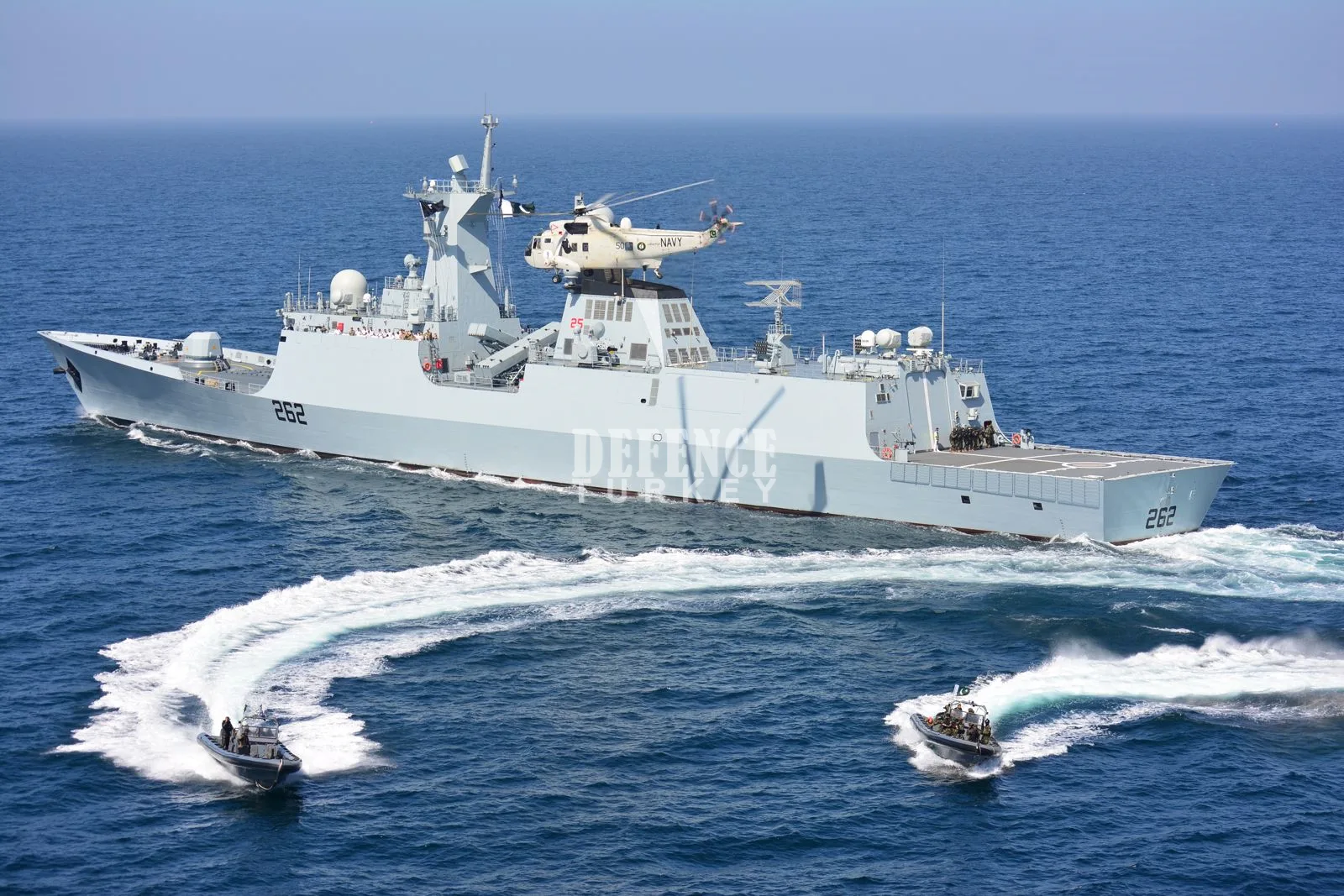
Admiral Naveed Ashraf, Chief of the Naval Staff of the Pakistan Navy, has outlined the service's modernization initiatives, regional partnerships, and strategic vision in an exclusive interview during the AMAN-25 naval exercise. The biennial event reflects Pakistan's commitment to maritime cooperation and regional security, with preparations for the 2025 edition expected to involve broader international participation. Admiral Ashraf emphasized Pakistan's focus on enhancing deterrence and operational capabilities while pursuing economical and indigenous solutions to maritime challenges.
Among the high-profile modernization efforts, the Pakistan Navy (PN) is integrating advanced platforms into its fleet. These include the Type 054 A/P frigates, equipped with multi-role capabilities and sophisticated weaponry for surface and air operations, and the locally built MILGEM/BABUR Class corvettes, developed under a Transfer of Technology (ToT) framework with Turkey. Submarine capabilities are also being bolstered with the acquisition of HANGOR Class submarines, featuring Air-Independent Propulsion (AIP) technology from China, enabling increased stealth in operations.
Further modernization efforts involve mid-life upgrades (MLU), such as Pakistan’s homegrown enhancements to F-22P frigates and the collaborative overhaul of Agosta-90B submarines, spearheaded alongside Turkey. The PN has also converted Embraer ERJ190 aircraft into long-range maritime patrol aircraft (Jet LRMPAs), expanding surveillance and operational reach. In addition, the introduction of JINNAH Class frigates, Pakistan's first large-scale indigenously designed warships, signals measurable progress in domestic shipbuilding capacity, reducing reliance on foreign vendors.
The PN's partnership with Turkey remains critical to its technological and operational advancements. Collaboration on MILGEM/BABUR Class corvettes and the Agosta-90B submarines demonstrates Turkey's role in reinforcing Pakistan’s naval capabilities. Admiral Ashraf acknowledged opportunities for future joint ventures in shipbuilding, weapon systems, and operational technologies.
Looking ahead, Admiral Ashraf shared the navy's strategic vision extending to 2035. The roadmap includes introducing advanced platforms such as Unmanned Combat Aerial Vehicles (UCAVs), Jet LRMPAs, and a fully modernized fleet of ships and submarines, aiming to preserve deterrence and maritime prosperity across the Arabian Sea.
Why this matters
Admiral Naveed Ashraf's detailed account highlights the operational imperatives driving naval modernization, particularly for regional maritime security stakeholders. For shipowners and operators in South Asia, Pakistan's evolving naval posture could influence routing decisions and risk assessments, given the PN's increased focus on deterrence in the Arabian Sea. Collaborative efforts with Turkey also underscore the role of international defense technology partnerships in enhancing maritime capabilities.
The PN's investments in indigenous shipbuilding mark a shift that could reduce reliance on foreign suppliers, enabling greater self-sufficiency. This development has implications for global naval yards that may see reduced procurement opportunities from Pakistan. Concurrently, Pakistan's emphasis on cost-effective solutions aligns with broader regional trends where fiscal constraints shape defense procurements.
In addition, the expansion of maritime surveillance capabilities via Jet LRMPAs could have indirect effects on monitoring shipping activities across critical trade corridors, especially in the Arabian Sea. This could serve as a counterbalance to regional adversarial naval developments, altering maritime risk profiles for commercial vessels navigating these waters.
Operators and maritime stakeholders should expect increased naval activity as Pakistan refines its capabilities ahead of the AMAN-25 exercise in 2025. The PN's modernization trajectory, particularly its focus on deterrence and technologically superior platforms, underscores the need for continuous evaluation of maritime security risks and regional dynamics.