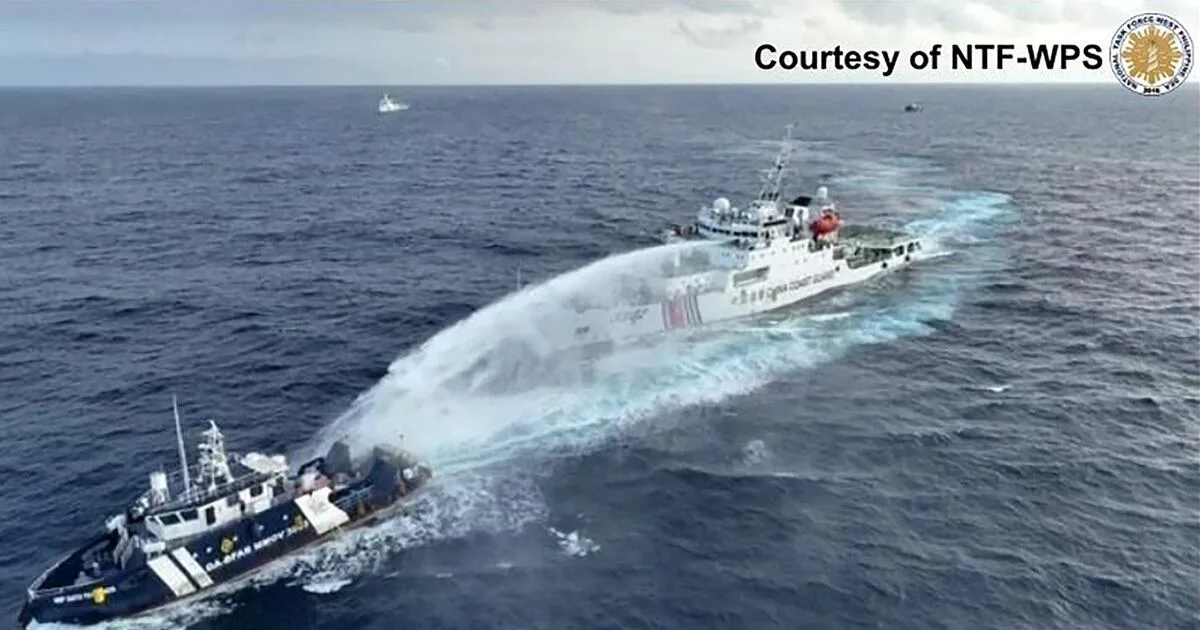
On Wednesday, tensions escalated between Manila and Beijing due to a maritime confrontation at the disputed Scarborough Shoal, following China’s recent submission of a chart to the United Nations to assert its territorial claims over the area. The China Coast Guard accused four Philippine ships of attempting to breach its territorial waters and making “dangerous” approaches to Chinese law enforcement vessels. In response, a Chinese spokesperson stated that this required their vessels to “exercise control” over the situation.
Conversely, the Philippines asserted that the Chinese coast guard used aggressive measures against its ships, including firing water cannons and sideswiping one of their vessels during a maritime patrol. Philippine Coast Guard spokesperson Commodore Jay Tarriela reported an incident where a Chinese vessel deliberately collided with the BRP Datu Pagbuaya, prompting Filipino crew members to shout about the collision. The Scarborough Shoal, known as Bajo de Masinloc in the Philippines and Huangyan Dao in China, is a critical point of contention, located roughly 125 nautical miles from Luzon, the Philippines’ main island. It has been under de facto Chinese control since 2012, with claims from China, the Philippines, and Taiwan.
This confrontation comes shortly after China deposited a statement regarding the “baselines of the territorial sea” around Scarborough Shoal at the U.N. The Chinese government described these actions as necessary to uphold its territorial sovereignty, arguing that they are in compliance with the U.N. Convention on the Law of the Sea (UNCLOS). The law defines baselines as lines along the coast from which territorial waters, exclusive economic zones (EEZ), and continental shelves are measured.
A 2016 U.N. arbitration ruling dismissed China’s expansive claims in the South China Sea, including those at Scarborough Shoal, determining it to be a rock instead of an island and restricting it to a 12-nautical-mile territorial sea without an EEZ. Despite this ruling, which underscored the shoal as part of the Philippines’ maritime jurisdiction, Chinese patrol boats continue to challenge Philippine vessels, obstructing their fishermen’s access to a lagoon within the shoal.
Insights from Philippine analysts suggest that China’s recent maritime activities are a reaction to new laws enacted by the Philippines defining its maritime zones—namely, the Philippine Maritime Zones Act and the Philippine Archipelagic Sea Lanes Act. Julio Amador III, a geopolitical analyst, indicated that China aims to assert that only its agencies have the authority to operate in the contested waters. Meanwhile, Professor Chester Cabalza commented on China’s strategy to dominate features in the South China Sea, suggesting that control over Scarborough Shoal would solidify Chinese dominance just off the western coast of Luzon.
The ongoing disputes reflect heightened geopolitical tensions in the region, with both nations affirming their claims to the contentious waters, further complicating the already intricate relationship in the South China Sea.