Captain Mark Vandroff discusses ethical behavior in leadership through a critique of Dale R. Wilson’s article. He emphasizes the challenges of defining “The Right Thing,” citing Lockheed Martin’s core value of “Do The Right Thing.” While companies and governmental bodies, like the Department of Defense (DoD), create frameworks for ethical conduct, Vandroff argues that ethical behavior transcends mere compliance with rules.
Using the example of a Navy Major Program Manager who bypassed contracting rules for urgent ship repairs, Vandroff illustrates that ethical conduct may sometimes conflict with established guidelines. This incident underscores that ethical actions can be situational, requiring nuanced judgment beyond rigid rule-following.
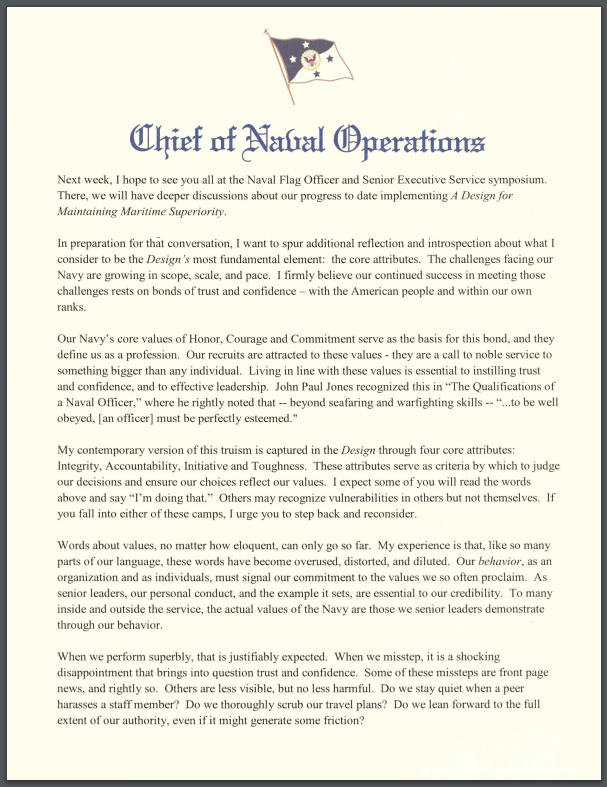
Vandroff proposes a definition of ethics as processes and principles that help discern right from wrong, recognizing that this often relies on a subjective evaluation of situations. He points out that ethical principles involve honesty, transparency, compassion, dignity, and courage, echoing sentiments voiced by Chief of Naval Operations Admiral John M. Richardson. Admiral Richardson cautions that eloquent proclamations about values must translate into behavior that demonstrates commitment to those values.
Drawing inspiration from historical philosophical discussions, Vandroff offers ten ethical principles applicable to defense professionals, encompassing military personnel, bureaucrats, and journalists. These principles serve as a guide for ethical decision-making rather than hard rules.
-
Alignment with Stakeholders: Actions should serve the legitimate interests of multiple stakeholders.
-
Balancing Conflicting Interests: Decision-makers must transparently balance the conflicting needs of stakeholders.
-
Legitimate Financial Benefits: Financial gains must come from transparent and legitimate sources.
-
Achieving Gain through Excellence: Personal or institutional gain should arise from merit, not exploitation.
-
Following Rule Sets: Rules should be adhered to unless they are unjust, with any deviation being conducted openly.
-
Authority Not for Personal Gain: Leaders must not exploit their authority for personal benefit.
-
Innate Human Dignity: Respect for all individuals is paramount in how they are treated.
-
Truthful Communication: Stakeholders must be provided truthful information relevant to their claims.
-
Avoiding Assumptions of Bad Intent: Ethical individuals judge others’ actions kindly, presuming good intent.
-
Addressing Wrongdoing: Ethical individuals must act against wrongdoing when encountered.
Vandroff concludes with a note on the need for strong ethical foundations to support effective rule sets. He acknowledges that while virtue and ethical principles are essential, they work best alongside well-defined rules, reinforcing the notion that there is no ethical way to do the wrong thing.
Overall, Vandroff advocates for a deeper understanding of ethics beyond compliance, highlighting its significance for leaders in the defense industry and advocating for open discourse on ethical principles.