
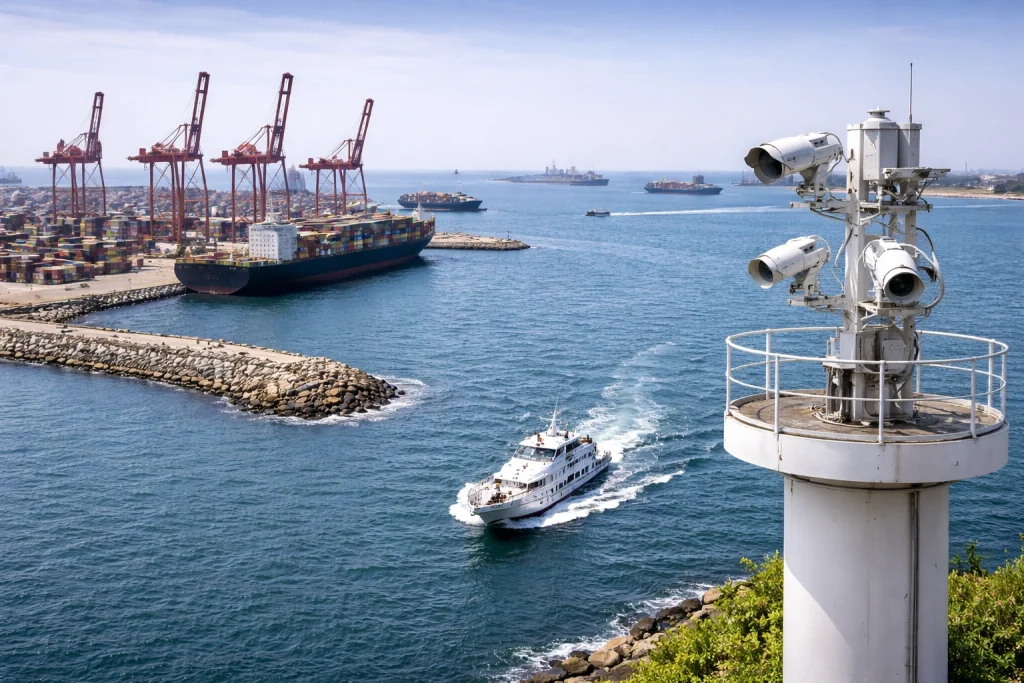
The Union government of India has established the Bureau of Port Security (BoPS) as a statutory body under the Merchant Shipping Act, 2025, aiming to enhance the nation’s maritime and coastal security framework. This initiative arises from the pressing need to address various security threats including smuggling, terrorism, cyber intrusions, and illegal migration, which have intensified with the exponential growth of India’s maritime economy.
India’s Maritime Landscape
With over 7,500 km of coastline, India hosts 12 major and 217 non-major ports. Major ports, managed by the Union government, handle more than half of the country’s maritime cargo traffic. Recent years have witnessed significant enhancements in port capacity and logistics efficiency due to increased coastal shipping and inland waterway activities. However, with this growth comes a heightened vulnerability to various security challenges, necessitating a robust national security strategy focused on securing ports and vessels.
Establishment of a Dedicated Authority
Previously, responsibilities for coastal and port security were fragmented across multiple agencies, including the Indian Navy, Coast Guard, and State maritime police. The absence of a centralized regulatory body often resulted in communication gaps and inconsistent implementation of security protocols. The creation of BoPS addresses these issues by establishing a singular, authoritative body responsible for overseeing port security similar to the Bureau of Civil Aviation Security (BCAS) for aviation.
Bureau of Port Security: Structure and Responsibilities
Operating under the Ministry of Ports, Shipping and Waterways, the BoPS focuses on regulatory oversight rather than direct operational duties. Its key responsibilities include standard-setting, enforcement of compliance, and coordination across both major and non-major ports. Vital areas of concern for the BoPS encompass maritime terrorism, drug trafficking, human trafficking, piracy, and illegal poaching, among others.
A crucial aspect of the BoPS is its focus on cybersecurity, given the increasing digitalization of port operations. By working in conjunction with national cybersecurity agencies, the Bureau aims to safeguard port IT infrastructure against cyber threats. Compliance with international standards, particularly the International Ship and Port Facility Security (ISPS) Code, is also within its purview.
Role of the Central Industrial Security Force (CISF)
The CISF has been designated as the primary security organization under the BoPS framework. It is tasked with developing standardized security plans, conducting assessments, and training private security personnel at ports. Security measures will be implemented on a risk-based approach, considering various factors including vulnerability, trade volumes, and threat levels, balancing security needs with business operations.
Strategic Alignment and Concerns
India’s maritime sector has grown significantly, with cargo volumes nearly doubling from 974 million tonnes in 2014 to almost 1,600 million tonnes by 2025. This development aligns with the Maritime India Vision 2030, which seeks to bolster world-class port infrastructure and ensure maritime safety.
However, some coastal states have raised concerns regarding port legislation that appears to centralize control over non-major ports with the Union government. Criticisms have also emerged about broad inspection powers granted to port authorities, underscoring ongoing debates about maritime federalism.
In conclusion, the establishment of the Bureau of Port Security marks a significant evolution in India’s maritime governance, aiming to create a more secure, integrated, and responsive maritime security architecture in response to the contemporary challenges faced by the nation’s expanding maritime economy.