China has recently released a comprehensive legal assessment aimed at undermining the legitimacy of U.S. “freedom of navigation” operations, claiming these practices lack a solid foundation in international law and are instruments of military coercion. The report, produced by the China Institute for Marine Affairs under the Ministry of Natural Resources, is characterized by Chinese officials as the first in-depth examination of U.S. navigation practices.
The assessment contends that U.S. actions not only distort international law but also impose self-curated legal standards. Zhang Haiwen, a former director general of the Institute, asserts that these U.S. operations prioritize American interests at the expense of other nations’ legitimate rights, portraying the American approach as a form of hegemonic power cloaked in legality.
The report evaluates U.S. legal positions on eleven critical issues, including the rules governing the innocent passage of warships, transit through archipelagic sea lanes, and military operations in exclusive economic zones. It argues that U.S. interpretations frequently contradict established international norms and are not aligned with the practices of many other nations.
Significantly, the document claims that the U.S. has introduced concepts like “international waters” and “high seas corridors,” which it argues infringe on the authority of coastal states, particularly affecting regions like the Taiwan Straits. Moreover, the report highlights perceived double standards within U.S. military operations, noting that while the U.S. avails itself of “freedom of overflight” in the air defense zones of other countries, it criticizes similar actions taken by non-allied nations.
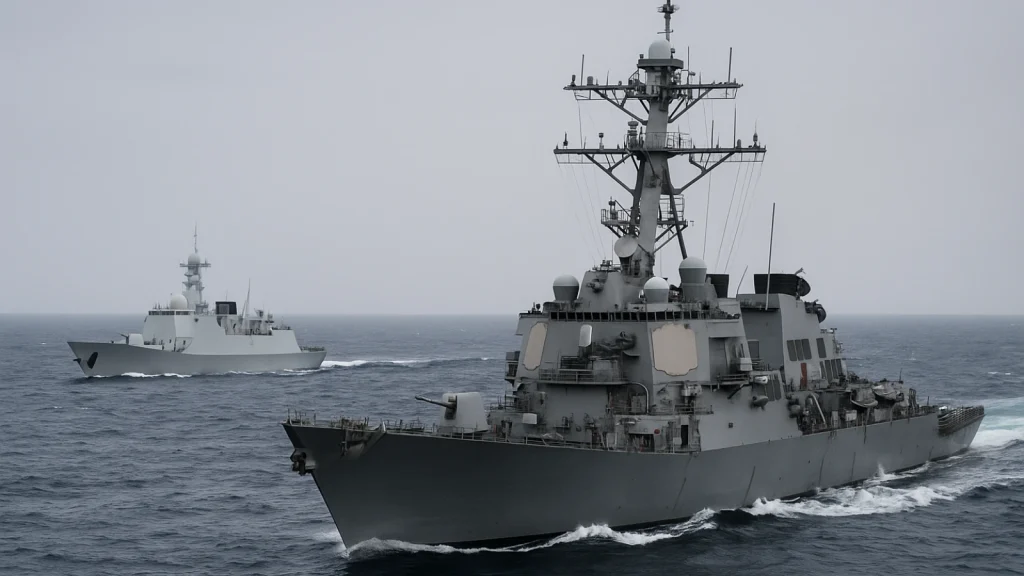
In a pointed statement, the assessment claims that U.S. freedom of navigation operations exacerbate geopolitical tensions and pose a threat to regional peace. Experts consulted in the report warn that these activities disrupt the international maritime order, increasing the risk of confrontations at sea and in the air. The report cites a specific incident involving the U.S. destroyer USS Higgins, which was expelled by the Chinese military after allegedly violating Chinese territorial waters.
Furthermore, the report critiques the U.S. for its selective adherence to the United Nations Convention on the Law of the Sea (UNCLOS), which it has not ratified but frequently references to justify its freedom of navigation initiatives. It traces the origins of the U.S. Freedom of Navigation Program back to 1979, noting its consistent use of military force to challenge state claims and to target what the U.S. deems “excessive maritime claims.”
Xu Heyun, the deputy director of the China Institute for Marine Affairs, emphasized that one main goal of releasing the report is to restore an international rule of law that he claims the U.S. undermines. He noted that the U.S. employs a selective interpretation of international law, applying it when convenient while disregarding it in other situations. The report ultimately aims to present a balanced perspective on maritime law and confront American practices deemed outdated and aggressive.
This evaluation not only showcases China’s discontent with the U.S. approach to navigation but also serves as a broader critique of U.S. hegemony in international waters, fostering ongoing debates about legality and power dynamics in maritime governance.