
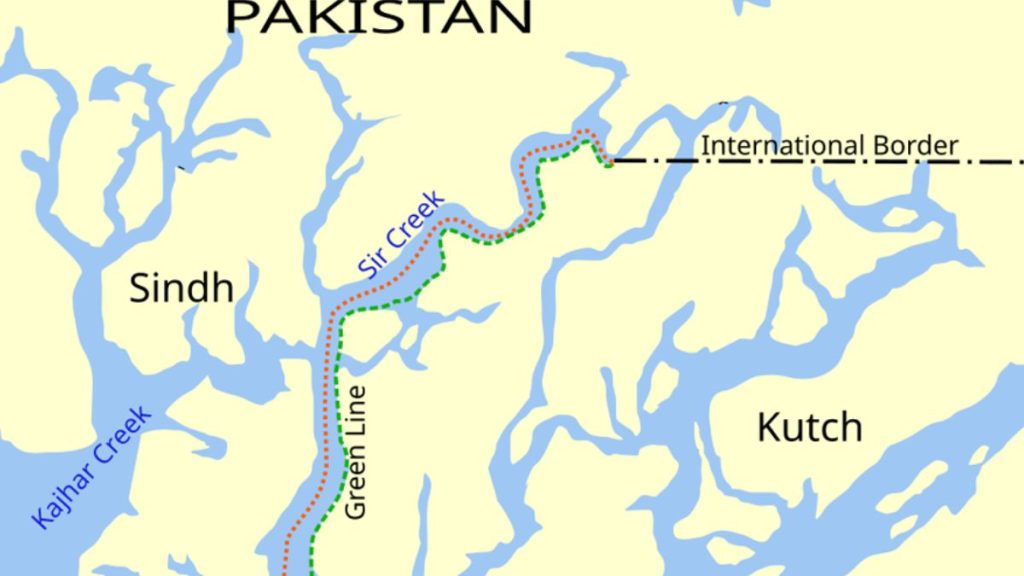
The Sir Creek dispute between India and Pakistan has resurfaced recently, highlighted by India’s Defence Minister Rajnath Singh’s firm warning against any hostile actions in the region. Singh’s remarks included a promise of a “resounding and decisive response” that could impact both “history and geography.” Although overshadowed by issues like Kashmir, the Sir Creek dispute remains a significant strategic and economic matter.
Understanding Sir Creek
Sir Creek is a 96-kilometer tidal estuary located in the Rann of Kutch, acting as a maritime boundary between Gujarat (India) and Sindh (Pakistan) as it flows into the Arabian Sea. Its significance lies in multiple factors:
- Security and Military Access: The estuary’s position is vital for military operations and surveillance.
- Fishing Rights: Local coastal communities depend on fishing rights, which are tied to territorial claims over Sir Creek.
- Energy Resources: Unresolved disputes affect the potential for oil and gas exploration in the adjacent waters.
- Exclusive Economic Zone (EEZ): The determination of EEZ boundaries is crucial for accessing marine resources.
Nature of the Dispute
The heart of the Sir Creek dispute lies in differing interpretations of a British-era document, the 1914 Bombay Government Resolution, which established boundaries between British-controlled Sindh and the Ruler of Kutch.
- Pakistan’s Position: Pakistan claims the boundary runs along the eastern bank of Sir Creek, thus granting them control over the area.
- India’s Argument: Conversely, India advocates for the thalweg principle, which delineates the boundary along the mid-channel of navigable waters, favoring India’s territorial claims. Pakistan contends that since Sir Creek is non-navigable, the thalweg principle should not apply.
In response, India asserts that Sir Creek is indeed navigable during high tides, fortifying its legal claim under international maritime law.
Strategic and Diplomatic Relevance
-
Military Tensions: Since Sir Creek sits near the international border, tensions can rapidly escalate with any perceived provocation. The Indian Navy and Coast Guard patrol the area, while Pakistan maintains a military presence on its side.
-
EEZ and Resource Claims: Control over Sir Creek influences the delineation of maritime boundaries and consequently the claims to fishing, oil, and gas resources, potentially affecting vast sea territories.
-
Diplomatic Dynamics: Although the issue has been raised in diplomatic dialogues, persistent mutual distrust and divergent strategic calculations have stalled resolutions, allowing the dispute to fester.
Recent Developments
In October 2025, Singh’s escalated statements about Pakistan’s potential aggression near Sir Creek suggest a hardening of India’s stance. This reaction may be influenced by increased Pakistani maritime activity or troop movements and aims to deter fishing-related intrusions or territorial claims.
Conclusion
The Sir Creek dispute signifies ongoing tensions between India and Pakistan, encompassing military, economic, and diplomatic dimensions. As both nations navigate a volatile regional security environment, developments around Sir Creek are likely to remain a focal point of contention.