
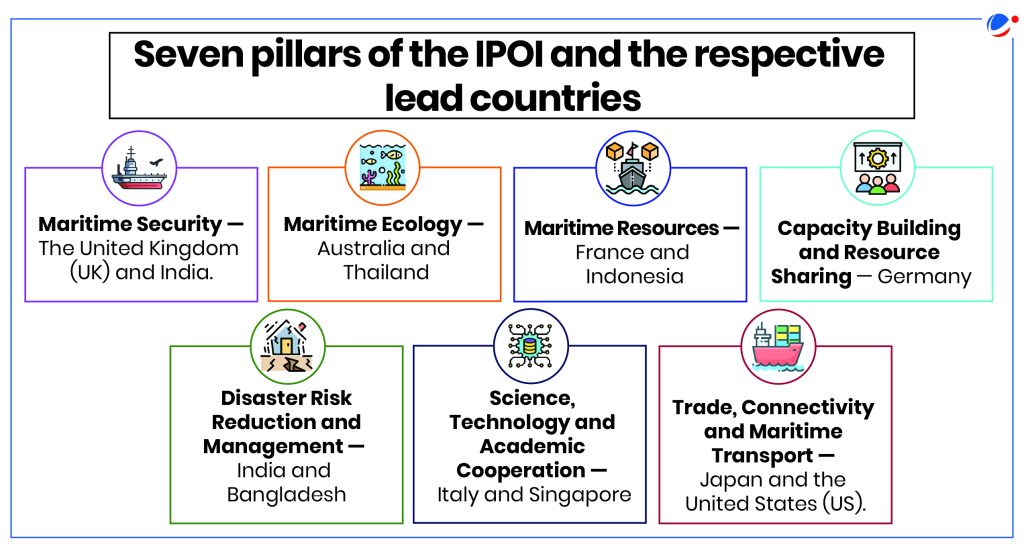
The Indo-Pacific Oceans Initiative (IPOI), launched by India in 2019 during the East Asia Summit in Bangkok, marks its fifth anniversary as a non-treaty-based voluntary framework aimed at fostering cooperation for a free and open Indo-Pacific region. The initiative seeks to cultivate a sense of community among like-minded nations through practical partnerships, echoing India’s earlier “Security and Growth for All in the Region” (SAGAR) initiative of 2015. SAGAR emphasizes inclusive development by balancing economic aid with maritime security within the context of international laws.
The term “Indo-Pacific” itself encompasses various interpretations. Geographically, it refers to the interconnected space between the Indian and Pacific Oceans, predominantly linked by the Malacca Strait. This region is pivotal, home to over half the global population and approximately two-thirds of the world’s economy. India sees the Indo-Pacific extending from East Africa to the Americas, while the U.S. defines it as reaching from India’s west coast to the Americas.
The IPOI significantly broadens the Indo-Pacific narrative, addressing a range of challenges beyond traditional security and geopolitical issues. It emphasizes economic, developmental, and environmental aspects within the maritime context, aiming to synchronize regional efforts towards maritime security and sustainable development. For example, it complements the ASEAN Outlook on the Indo-Pacific, and collectively they help respond to challenges, such as China’s assertiveness in the region, as evidenced by India and Vietnam’s strengthened bilateral collaboration in 2020.
One of the primary objectives of IPOI is to enhance maritime security through cooperative engagement among partners while addressing critical resource geopolitics involving minerals and rare earth elements. This flexible framework allows for the adaptation of regional cooperation strategies to tackle emerging challenges effectively.
However, the IPOI faces several key challenges, including institutional deficiencies due to the lack of a clear agenda for multilateral cooperation, as well as escalating geopolitical tensions, particularly from China, which perceives the initiative as a containment measure. Additional hurdles include resource limitations, with uneven funding and technological capabilities among member nations, regulatory harmonization obstacles, and inclusivity concerns that limit participation from East African and Gulf Cooperation Council countries.
To advance the IPOI, it is essential to establish a comprehensive vision and a broad agenda derived from ongoing discussions. Developing pillar-specific dialogues and encouraging greater involvement from underrepresented regions could enhance the initiative’s regional framework. Furthermore, annual updates on each pillar would aid in fostering a common understanding and direction.
In conclusion, India’s approach to the Indo-Pacific, part of its Act East policy, promotes inclusivity and freedom of navigation. By nurturing partnerships with regional players like Japan, South Korea, and Australia, India aims to establish a balanced and cooperative maritime environment for all nations involved.
Source link