
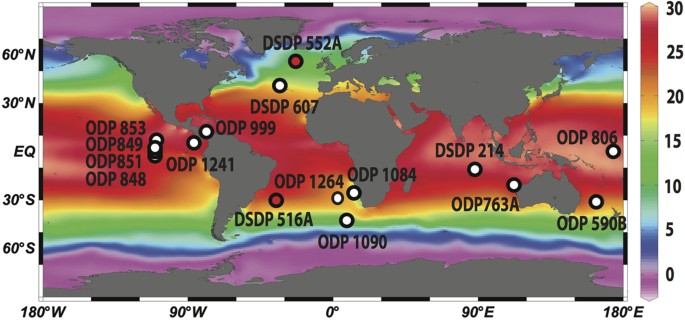
The collection of studies discusses the geological and oceanographic impacts of the formation of the Isthmus of Panama, highlighting its crucial role in reshaping ocean circulation and climate during various geological epochs. The initial collision of the Panamanian region with South America, marked by the work of Farris et al. (2011), established the structural foundation for further tectonic and geomorphological changes.
Following the isthmus’s formation, research by Montes et al. (2015) emphasized the Middle Miocene closure of the Central American Seaway, a significant event that altered marine pathways and ecological dynamics. This closure caused shifts in oceanographic conditions, significantly impacting the Atlantic and Pacific oceans, as evidenced by Osborne et al. (2014) and Sepulchre et al. (2014), who analyzed neodymium and lead isotope records. These studies revealed profound changes in marine environments due to variations in water mass properties and thermohaline circulation.
The work of Haug and Tiedemann (1998, 2001) underlines the effect of the Isthmus of Panama on Atlantic thermohaline circulation, suggesting that its uplift played a fundamental role in regulating oceanic freshwater balance. This shift influenced global climate patterns, particularly in relation to ice ages and heat distributions across oceans, as explored by various researchers including Lunt et al. (2008) and Karas et al. (2009).
Notably, further investigations by Brierley and Fedorov (2016) compared the climatic consequences of inter-ocean gateway changes, notably during the Miocene and Pliocene. These studies illustrated how the closure of the Central American Seaway led to significant climatic shifts, with implications on global temperatures and sea-level changes.
The Pliocene epoch saw the manifestation of these developments substantially influencing ocean stratification, as outlined by Steph et al. (2010) and subsequent modeling studies. The closure of the seaway not only modified marine circulation but also triggered broader climatic transitions leading into the Quaternary period.
Overall, the synthesis of these studies portrays the Isthmus of Panama not just as a geographical barrier but as a transformative force in oceanic and climatic evolution. As researchers continue to investigate the interplay between tectonic activity and climate, these early geological events provide a foundational understanding of contemporary ocean systems and climatic behavior. This interplay remains crucial for predicting future climate dynamics in response to ongoing environmental changes.
Source link