
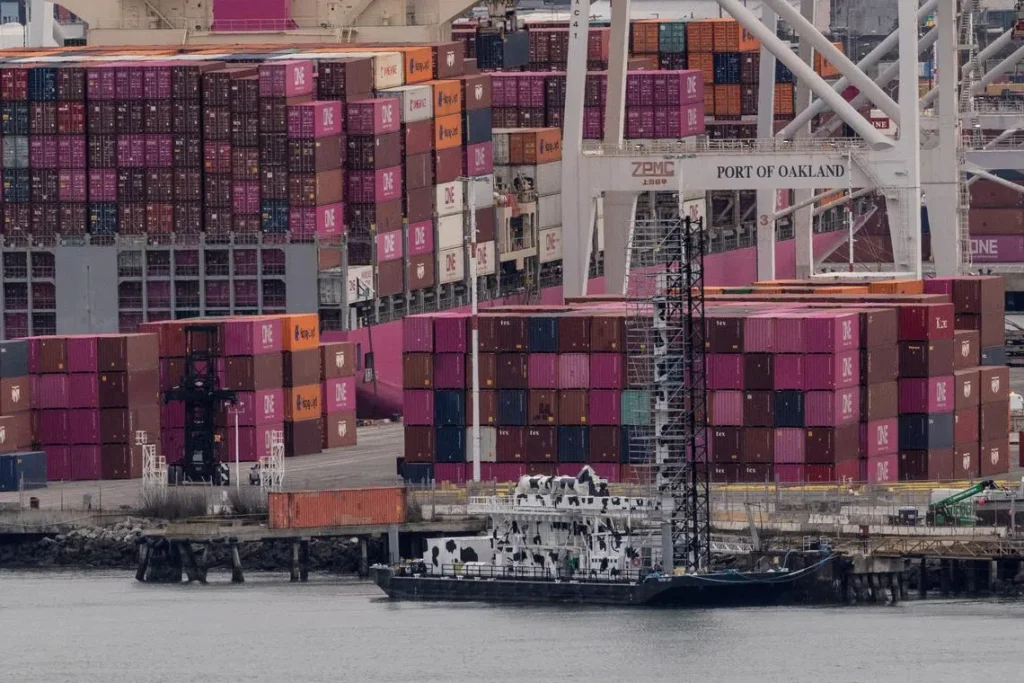
The ocean shipping industry is facing significant challenges due to U.S. President Donald Trump’s evolving tariff policies, which have ignited concerns about a potential trade war and its repercussions on transport demand. As the Trump administration prepares to announce “reciprocal tariffs” targeting countries with existing duties on U.S. goods, the anxiety in the shipping sector is palpable. This follows the imposition of new import levies on products from major trading partners such as Mexico, China, and Canada, as well as from industries like steel and automotive.
Global shipping giants like MSC, Maersk, CMA CGM, and Hapag-Lloyd, which together handle a significant portion of the $14 trillion ocean shipping market, are particularly impacted. These companies transport containers filled with goods for major U.S. retailers like Walmart and Home Depot, relying heavily on stable trade conditions. However, the rapid and sometimes unpredictable changes in tariff policy have created confusion and uncertainty among importers.
Blake Harden, a vice-president at the Retail Industry Leaders Association, highlighted the lack of preparation time for industries to comply with shifting tariffs. Kit Johnson, a customs broker, noted that importers often find themselves uncertain about their duty costs from week to week, with some opting for more expensive air freight in an attempt to circumvent the increasing tariffs. This has led to a surge in U.S. container imports, as companies rush to bring in goods from China and other regions before tariffs are applied.
Recent data indicates a notable spike in shipping costs, with spot rates for containers between the Far East and the U.S. West Coast reaching $2,844, reflecting a 16% increase in just one day. Despite this, the rates remain lower compared to the previous year, during which pricing was also disrupted by geopolitical events.
The ongoing tariff disputes present a temporary solution for companies resorting to front-loading inventory, yet experts caution that such strategies may only provide short-term relief. Trump’s proposed port call fees for ships operating in China could exacerbate existing issues, potentially damaging U.S. agriculture and energy exports and creating additional chaos at ports.
As various tariffs compound, shipping executives express concern about the unpredictability affecting supply chain decisions. A Greek shipping executive stated that clients are in a “wait-and-see” mode, hesitant to load cargo amid potential future levies.
Experts are beginning to assess the toll of these tariffs on the U.S. manufacturing sector, which crucially relies on imports and exports. According to a survey by the Institute for Supply Management, apprehension regarding tariffs has hindered recovery in this sector. Projections from S&P Global Market Intelligence suggest that U.S. ocean container freight imports may decline by 0.7% by 2025 as tariffs take their toll.
In light of the evolving situation, U.S. Customs and Border Protection is working to revamp systems to manage new tariffs, highlighting the complications of administering these changes. Johnson reiterated that the increasing number of tariffs complicates compliance for businesses, indicating a future filled with uncertainty for the shipping industry.
Source link