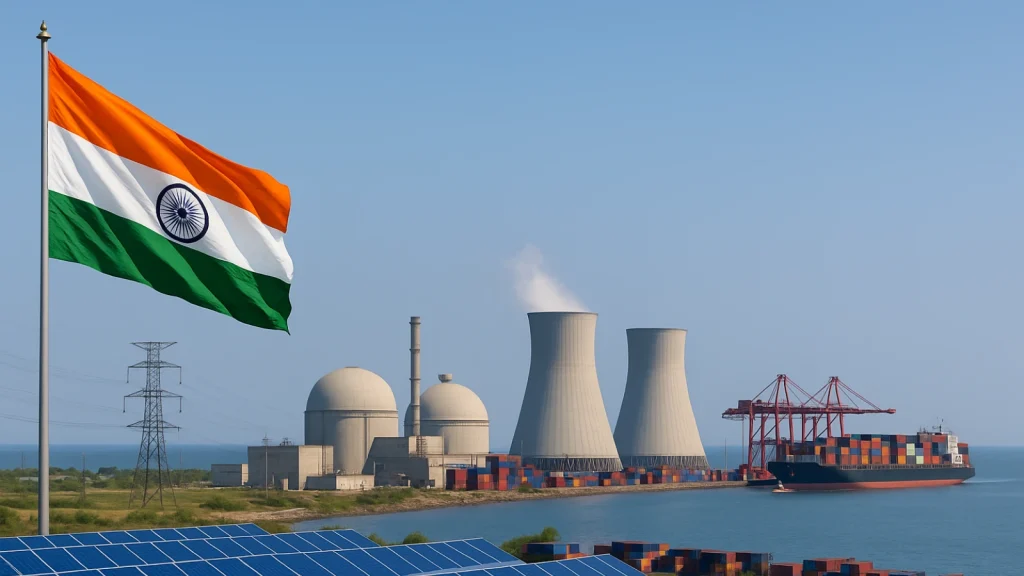
India is strategically advancing its nuclear energy capabilities through the introduction of Small Modular Reactors (SMRs) under the Bharat Small Modular Reactors (BSMR) initiative by the Nuclear Power Corporation of India Ltd (NPCIL). Six prominent private sector companies—Reliance Industries, Tata Power, Adani Power, Hindalco Industries, JSW Energy, and Jindal Steel & Power—have expressed interest in establishing these projects. A total of 16 potential sites across six states, including Gujarat and Madhya Pradesh, have been identified for this initiative.
The SMRs, which range from 30 to 300 MWe per unit, present a viable and compact solution for producing low-carbon electricity, making them suitable for energy-intensive sectors such as steel, aluminum, and cement. They can also be installed at sites of decommissioned thermal power plants, aiding in infrastructure reuse while promoting clean energy. The management structure allows public ownership under NPCIL, while private partners will fund the entire lifecycle costs of the projects in exchange for a long-term, reliable power supply for their industrial operations.
Globally, the SMR landscape is evolving, with operational projects such as Russia’s Akademik Lomonosov and China’s HTR-PM. International developers like Holtec International and Rolls-Royce are actively engaged in advancing SMR technologies. This wave of global interest is further fueled by technological giants such as Google and Microsoft, who are exploring nuclear options to meet the substantial and continuous power needs of data centers, which struggle with the intermittency of renewable energy sources.
Yet, despite their potential, SMRs face significant hurdles, including high costs, regulatory complexities, and public concerns regarding nuclear safety. There are ongoing debates on their commercial viability and the ability to attract consistent private investment. India’s recent policy shifts allow for private participation under NPCIL’s supervision, marking progress in harnessing the benefits of SMRs while addressing associated risks.
India’s commitment to SMRs signifies a major step towards its clean energy transition. The government has allocated ₹20,000 crore towards a Nuclear Energy Mission aimed at research and development in SMR technology, with a goal of developing and commissioning at least five indigenously designed SMRs by 2033.
While India’s existing capabilities lie in Pressurised Heavy Water Reactors (PHWRs), there is a pressing need to modernize its nuclear reactor designs to align with international standards, primarily the Pressurised Water Reactor (PWR) systems. India is intending to diversify its SMR designs, which includes the Bharat Small Modular Reactor (BSMR) and Bharat Small Reactor (BSR), while ensuring its technology remains competitive in the global arena.
Ultimately, the initiative positions India not only as a potential leader in the global SMR market but also as a key player in its own industrial decarbonization and energy security, paving the way for a sustainable nuclear energy future.