
Vietnam has ordered Spanish oil firm Repsol to halt its exploration and production (E&P) activities at Block 136-03, located near Vanguard Bank in the South China Sea, following alleged threats from China. Diplomatic sources indicate that China threatened to attack Vietnamese installations in the Spratly Islands if Repsol continued its work.
Vanguard Bank is approximately 200 nautical miles southeast of Vung Tau, and Vietnam has maintained manned outposts in the area since the late 1980s to deter Chinese territorial ambitions. While Vietnam asserts that the surrounding waters are part of its exclusive economic zone (EEZ), these waters also lie within China’s extensive “nine-dash line” claim, which the Permanent Court of Arbitration invalidated last year, ruling that China’s claims lack legal basis under the United Nations Convention on the Law of the Sea (UNCLOS). Despite the ruling, China has largely disregarded it.
The exploration lease at Vanguard is jointly owned by Vietnam’s state-controlled PetroVietnam, the UAE-based Mubadala Development, and Repsol as the lease operator. Repsol is utilizing the sixth-generation ultradeepwater drillship Deepsea Metro I for its operations, and reports suggest that the company may have recently discovered a significant gas reserve at Vanguard prior to being instructed to halt work.
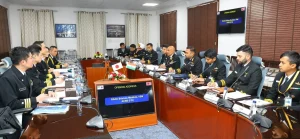
The tension surrounding this dispute has escalated over the past month. In mid-June, after a meeting between Senior Lieutenant General Fan Changlong, vice chairman of China’s Central Military Commission, and senior Vietnamese officials, Fan canceled Chinese participation in a planned cross-border “friendship meeting.” Sources indicate that during this meeting, Fan requested that Vietnam refrain from drilling at Block 136-03.
In response to the suspension of drilling, Chinese Foreign Ministry spokesman Lu Kang stated that China urges Vietnam to cease its “unilateral infringing activities” and to take practical steps to maintain the “hard-earned positive situation” in the South China Sea.
The historical context between China and Vietnam is marked by significant tensions over E&P activities in the South China Sea. A notable incident occurred in 2014 when China attempted to drill in Vietnamese-claimed waters near the Paracel Islands, resulting in a standoff that involved over 100 Chinese vessels. Additionally, during this confrontation, a Chinese fishing vessel allegedly sank a Vietnamese boat. Tensions have surged again in 2015 and 2016, with further Chinese drilling operations near the Paracels, leading to growing concerns of additional confrontations.
Overall, the situation exemplifies the ongoing geopolitical struggles in the South China Sea, where issues of territorial claims and resource exploration continue to fuel tension between China and Vietnam. The halt of Repsol’s drilling marks a significant development in this fraught maritime dispute, reflecting the precarious balance of power in the region.