The shipping industry is increasingly focusing on green corridor initiatives as part of the drive toward achieving net-zero emissions. To facilitate this transition, the availability of clean fuel supplies, along with adequate storage and bunkering infrastructure, is crucial. Transparency and stability in regulations will be essential for both producers and consumers of green fuels to ensure compliance with EU targets.
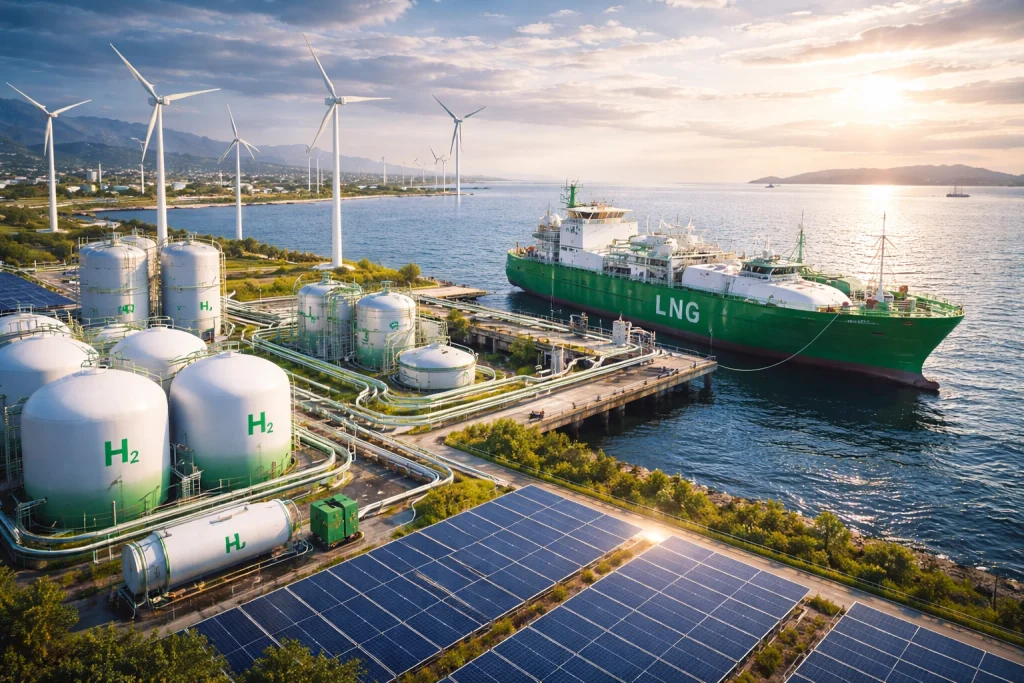
Madoqua, a Luso-Dutch company, is making strides in the Power-to-X (PtX) sector, aimed at producing and marketing hydrogen and its derivatives such as green ammonia and e-methanol. Central to their efforts is the Madoqua Green Fuels Terminal, a key infrastructure component designed to connect Portugal with Northern Europe.
In late 2024, Madoqua partnered with the Ports of Sines, Rotterdam, and Duisport to establish a green fuels corridor. They are collaborating with industry partners, including Copenhagen Infrastructure Partners and Mitsui O.S.K. Lines, to explore innovative business models and share risks in this energy transition. The company is open to partnerships that contribute socio-economic value and foster sustainable coexistence.
Current progress in developing the green fuels corridor includes the creation of an Ammonia Bunkering Operations Manual to facilitate the safe adoption of ammonia in marine fuel. Madoqua is concluding a feasibility study on the green fuels terminal in Sines, for which they have received support from the EU via the Connecting Europe Facility. While the ammonia storage component is advancing, the project faces challenges related to ensuring continuous product flow to stimulate demand.
Madoqua’s terminal will initially focus on ammonia storage and is based on an open-access model to unlock regional green fuel projects. Their green ammonia project has a phase one target of 500 MW of electrolysis capacity, with additional grid access secured for expanded production.
Regulatory frameworks such as the upcoming FuelEU Maritime regulation are poised to impact green fuel production and bunkering infrastructure significantly. A future demand for renewables in maritime fuels mandates a substantial acceleration in production capacity, as establishing new facilities is time-intensive.
Looking ahead, Madoqua sees opportunities for more green fuel corridors arising, particularly as EU support increases for public-private collaborations. The Global South is identified as a potential source for green fuel supply, particularly in regions like Morocco and Namibia, although core infrastructure development remains a barrier.
Challenges such as price discrepancies and regulatory inadequacies can hinder the maritime industry’s transition to green fuels. Ras emphasizes the need for incentives that not only support fuel producers but also encourage consumers to adopt greener practices.
To ensure adequate supplies in the maritime sector, stable regulatory frameworks and active collaboration between utilities and policymakers are essential. Although many projects currently lack the right fundamentals for viability, Madoqua is experiencing encouraging demand for its green fuels initiative, moving towards a phase two expansion that will require significant renewable energy input. The urgency for action is evident, as the window for making the necessary transitions is closing rapidly.