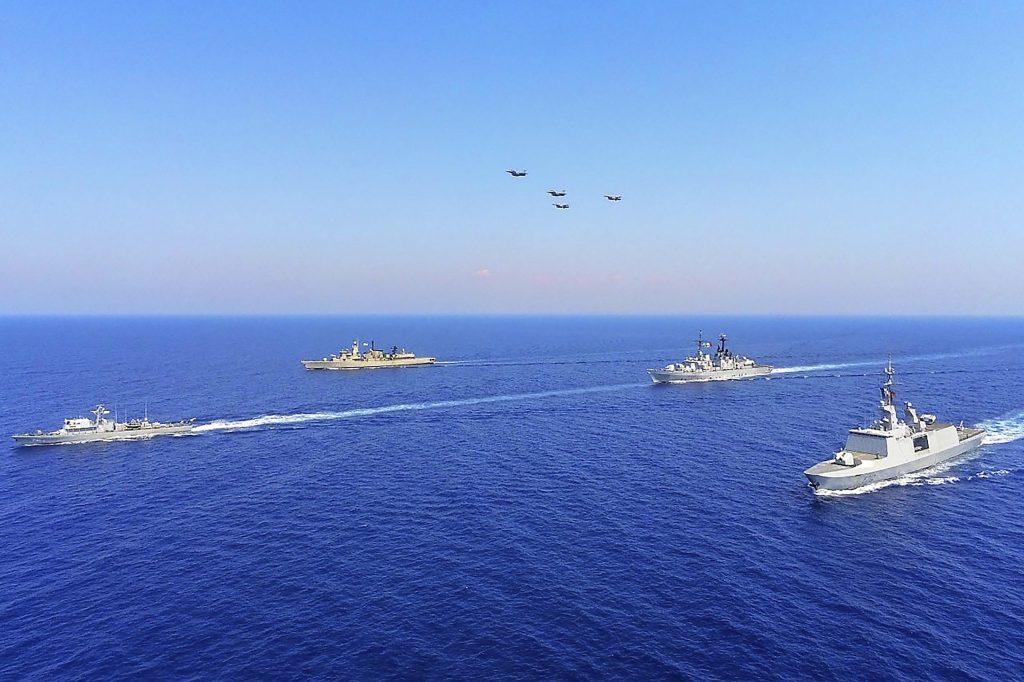
From August 26-28, 2020, Greece, Italy, Cyprus, and France conducted joint military exercises in the Eastern Mediterranean Sea, highlighting rising tensions in maritime security. On August 9, the UN Security Council, under India’s presidency, held a pivotal debate on maritime security, attended by major leaders, including India’s Prime Minister Narendra Modi, Russian President Vladimir Putin, and Kenyan President Uhuru Kenyatta. The discussion was crucial in the context of increasing piracy, maritime terrorism, and general incidents at sea.
While maritime security lacks a universally accepted definition, it encompasses three key dimensions: interstate disputes, extremist violence, and blue crimes (criminal activities at sea). The interstate dimension focuses on territorial disputes and violations of international law, exemplified by conflicts in the South China Sea and the Arctic. The violence dimension is characterized by extremist groups attacking ships, using maritime routes for smuggling and funding, such as Abu Sayyaf in Southeast Asia and al-Shabaab in Somalia. The blue crimes dimension includes piracy, human trafficking, drug smuggling, illegal fishing, and environmental violations.
The UN has a historical framework addressing such challenges, notably through the UN Convention on the Law of the Sea (UNCLOS) established in 1994, alongside institutions like the International Tribunal for the Law of the Sea. In the past decade, the UN Security Council has increased its focus on maritime security, issuing resolutions and engaging in discussions about combating piracy, human trafficking, and environmental concerns tied to maritime activities.
However, despite the efforts, current approaches tend to be fragmented and siloed, emphasizing localized responses rather than a unified global strategy. During the UN debate, several nations, including the U.S., advocated for enhanced multilateral mechanisms for information sharing and collaboration on maritime security issues. Modi suggested a new cooperative framework, while Russia proposed establishing a dedicated structure within the UN to address maritime crime comprehensively.
Discussions identified challenges related to existing regional mechanisms, noting a proliferation of informal and formal bodies without adequate coordination, which could lead to overlapping responsibilities and unaddressed issues. The debate raised the possibility of establishing a UN body specifically focused on blue crimes, which could coordinate information sharing and best practices globally. A new institutional arrangement could mirror existing bodies that address counterterrorism or cybersecurity, potentially integrating industry stakeholders essential in combatting maritime crime.
Creating an effective response requires extensive dialogue on whether to establish a new commission, committee, or forum and what its structure might entail, including regional and issue-specific subgroups. An initial step could be forming a high-level panel of experts to evaluate these options.
The August 9 debate showcased global leadership’s commitment to tackling maritime security concerns, reflecting a shared recognition of the need for cohesive responses to complex maritime challenges. Moving forward, a strategic approach is crucial to enhance maritime security and safeguard international waters.
Source link