
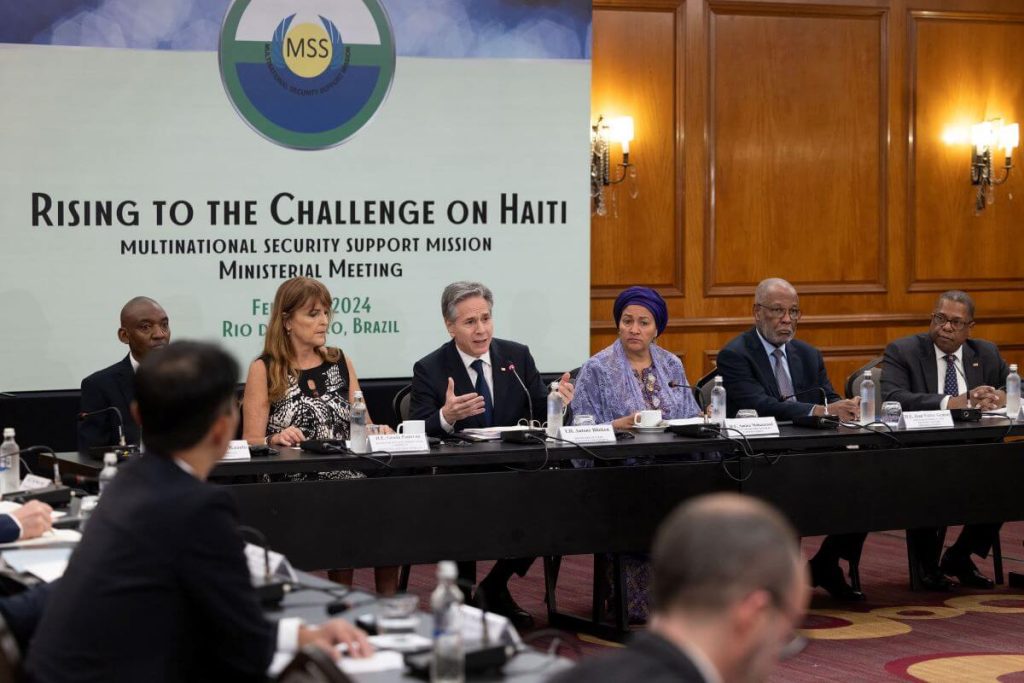
Summary: Addressing the Crisis in Haiti through the MSS Mission
Haiti is currently grappling with a profound crisis marked by governance collapse, escalating gang violence, and severe humanitarian challenges. Since 2019, the nation has faced negative economic growth and rampant inflation, severely impacting its population. In 2024 alone, over 3,200 killings have been reported, with more than 5.5 million people requiring humanitarian aid and nearly half of the population experiencing food insecurity.
In response, the United States has proposed a three-pronged strategy: establishing a transitional government, restoring security, and initiating constitutional reforms followed by elections. Central to this strategy is the Multinational Security Support (MSS) mission, primarily led by Kenyan police and supported by various international forces. However, the mission, authorized by the UN Security Council on October 2, 2023, has faced multiple delays and concerns regarding its funding and operational clarity, with only 400 Kenyan officers deployed to date and lacking a definitive mandate.
Key Issues with the MSS Mission
-
Lack of Engagement and Transparency: The MSS mission has been criticized for its limited involvement of Haitian stakeholders and civil society, raising questions about its legitimacy. The provisional government of Haiti struggles to confer credibility to the operation, which lacks clarity in mission objectives and operational guidelines. The disparity between local expectations for a robust response to gang violence and the MSS’s focus on infrastructure security exacerbates public mistrust.
-
Absence of Accountability Mechanisms: The lack of safeguards against human rights violations poses significant risks. The MSS mission’s structure does not provide clear avenues for addressing complaints, leading to potential abuses similar to those witnessed during prior interventions, such as MINUSTAH.
-
Short-Term Focus and Neglect of Local Forces: The MSS mission’s design perpetuates reliance on foreign troops at the expense of sustainable support for the Haitian National Police (PNH). With a budget three times that of the PNH, the mission prioritizes foreign police salaries over local force development, leading to low morale and high attrition rates among Haitian police.
-
Military-Centric Approach: The mission’s military-focused strategy neglects the underlying factors driving gang violence, such as complex political dynamics and transnational influences, including illicit arms trafficking from the U.S. A more effective strategy would address these systemic issues rather than solely targeting gang members.
The Call for a New Approach
The current reliance on foreign intervention has not yielded long-term stability and has often led to socioeconomic and human rights issues. A new approach is imperative, which may include:
-
Increasing Haitian Ownership: Engage local civil society in the planning and implementation of security initiatives, establishing a National Security Council as outlined in recent agreements.
-
Investing in Local Security Forces: Redirect resources to strengthen the PNH through training, equipment, and logistical support, while promoting officer retention.
-
Establishing Accountability Mechanisms: Create an independent body to monitor MSS personnel and address misconduct, ensuring compliance with international human rights standards.
-
Disrupting Gang Networks: Implement strategies to sever the connections between gangs, politicians, and businesses, including comprehensive sanctions and thorough investigations.
-
Regional Cooperation: Develop strategies to tackle the flow of illegal arms and goods supporting gang activities, facilitating collaboration among regional law enforcement agencies.
By adopting a holistic and inclusive approach, the international community can help create a sustainable path toward security and stability in Haiti, ultimately breaking the cycle of dependency and violence.