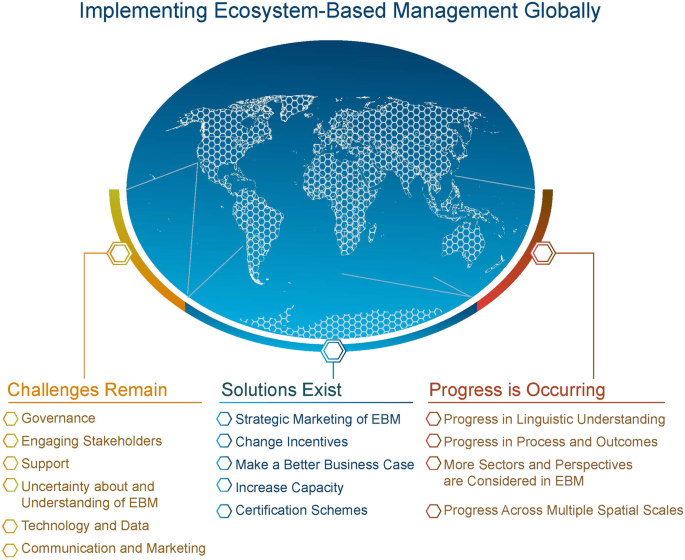
Summary of Impediments and Solutions for Ecosystem-Based Management (EBM)
Governance Challenges
The implementation of Ecosystem-Based Management (EBM) faces significant governance-related impediments. A prevalent concern is the lack of political will among decision-makers who often lack awareness of EBM’s benefits or assume it is too complex and costly. Bureaucratic inertia, influenced by institutional silos, further complicates the situation, leading to harmful inaction being more acceptable than potentially harmful decisions. Governance lacks a clear mandate for EBM, and existing policies are insufficiently coordinated across different scales and jurisdictions, particularly between local and national authorities.
Solutions to Governance Issues
Addressing these challenges requires fostering better cross-sector decision-making through strong leadership that understands the need for balancing environmental, social, and economic outcomes. Collaborations between local governance systems and regional institutions are essential, as are efforts to create bridging organizations that connect institutional silos. By promoting open and transparent dialogues among stakeholders and employing incentives for collaboration, EBM can be incrementally implemented despite existing bureaucratic barriers.
Engaging Stakeholders
Effective EBM relies on the involvement of diverse stakeholders. However, there is an imbalance of power, with resource-rich sectors often overshadowing underrepresented groups. To overcome this, solutions include revising incentives to encourage cooperation across sectors and building capacity among poorly resourced stakeholders. Ensuring clear communication and organized participation is crucial for engagement.
Support and Resources
A disparity exists between the promised and actual support for EBM from various organizations and jurisdictions. Financial and institutional backing is essential but often lacking. Persistent political motives remain the backbone for actual EBM funding. To ensure long-term support, stakeholders need to articulate a strong business case that shows the economic, social, and environmental benefits of EBM.
Understanding and Knowledge of EBM
Confusion surrounding EBM often hinders its implementation. A broad range of interrelated terms creates uncertainty among policymakers and stakeholders. Continuous communication and educational efforts are necessary to clarify the concept and encourage its broader application across various management contexts.
Data Availability and Transparency
The assumption that a lack of data impedes EBM is misleading; often, insufficient political will and support are more significant barriers. Utilizing existing data effectively and fostering transparency among sectors is essential. Data integration and cooperation among stakeholders can enhance decision-making processes.
Communication Strategies
Ineffective communication is another impediment to EBM. A lack of understanding among the public and stakeholders regarding EBM’s relevance and implications leads to underutilization of the approach. Strategic communications and marketing initiatives that engage a broader audience and clarify EBM’s purpose are necessary to foster public support and interest.
Integrated Solutions
The workshop results indicate that implementing interconnected solutions can address multiple impediments simultaneously. Approaches such as EBM marketing, capacity building, and creating certifications can drive awareness and interest in EBM. Recognizing that solutions are often interrelated can lead to more comprehensive strategies, with stronger public engagement prompting increased political support.
Progress in EBM Implementation
Despite various challenges, progress in EBM implementation is evident, with enhanced collaboration and increased engagement across diverse sectors. Innovations in management approaches demonstrate that EBM principles are already being integrated, even if not explicitly labeled as such. Continued efforts are needed to enhance engagement and coordination across ocean-use sectors to mitigate conflicts and encourage sustainable practices.
In conclusion, while numerous obstacles to EBM implementation exist, promising solutions and a commitment to continuous improvement can foster successful ecosystem management globally.