
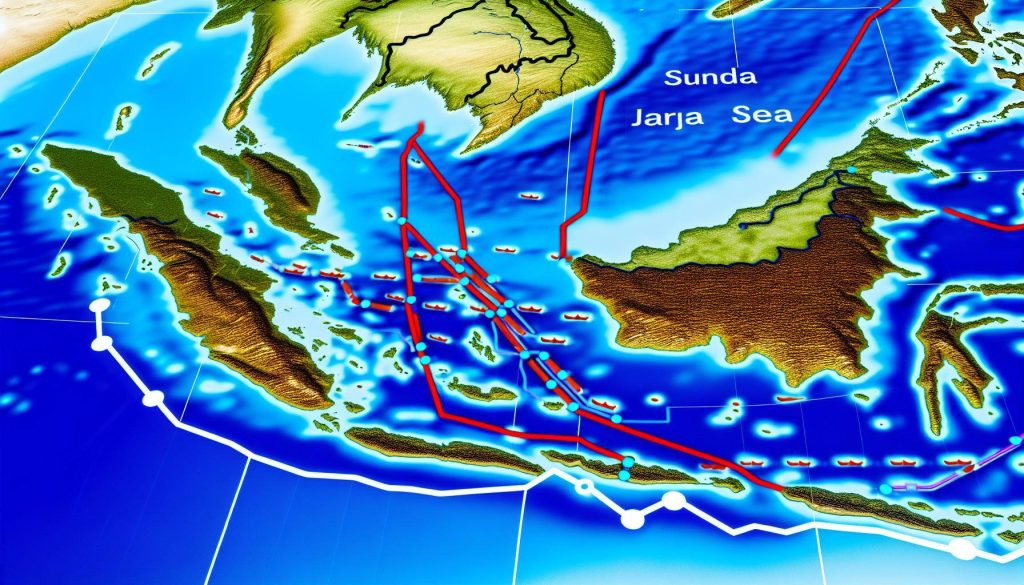
The Sunda Strait, nestled between Java and Sumatra in Indonesia, acts as a crucial maritime passage that links the Indian Ocean with the Java Sea, extending connectivity to the South China Sea and the Pacific Ocean. While the Malacca Strait serves as the primary route for shipping between these vast oceans, the Sunda Strait emerges as a vital alternative, particularly during times of congestion or conflict. Its strategic importance is highlighted by the avoidance of the high-traffic Malacca Strait, which is often fraught with piracy and geopolitical tensions.
Indonesia plays a significant role in governing the Sunda Strait, which is pivotal for ensuring secure maritime passage for global trade. This strait’s economic importance is considerable, as it facilitates the transport of substantial volumes of energy, commodities, and manufactured goods. The ongoing power dynamics in the region, especially between the United States and China, further amplify the strait’s value, as it serves as a key conduit for global trade.
Maritime security remains a dominant concern in the Sunda Strait, with the persistent threat of piracy affecting transportation costs and insurance rates. In military contexts, the strait functions as a strategic chokepoint for naval operations, especially during heightened tensions. The United States maintains a robust naval presence in the region to safeguard essential maritime routes, working alongside its allies. Concurrently, China’s Belt and Road Initiative reflects its strategic interests in enhancing maritime infrastructures in these waters.
The regional security landscape is also shaped by the Andaman and Nicobar Islands, along with Sabang in Indonesia. Positioned at the eastern entry to the Malacca Strait, the Andaman and Nicobar Islands afford India a strategic advantage, reinforcing its Act East Policy and countering Chinese influence. Simultaneously, Indonesia’s development of Sabang into a maritime hub emphasizes its strategic aspirations in regional security and trade.
The intertwining of geopolitics and geoeconomics in the Indo-Pacific is further complicated by issues such as piracy, territorial disputes, and the proposed Kra Canal in Thailand. The U.S. and its allies undertake Freedom of Navigation operations to ensure the openness of maritime routes and to challenge excessive maritime claims, particularly those of China in the South China Sea.
The interaction between rising powers like China and established ones such as the U.S. illustrates the concept of the Thucydides Trap, which posits that a rising power often leads to conflict with an established power. This is manifested in overlapping territorial claims and strategic uncertainties in the region. Additionally, greyzone methods involving economic, territorial, and informational strategies between India and China influence regional dynamics without resorting to direct military confrontation.
In summary, the Sunda Strait and its adjacent areas are critical elements in the geopolitical landscape of the Indo-Pacific, serving vital roles in global trade and military strategies. The ongoing geopolitical maneuvers will continue to shape the balance of power in the region, underscoring the intricate blend of strategy, economics, and conflict in this dynamic area.
Source link