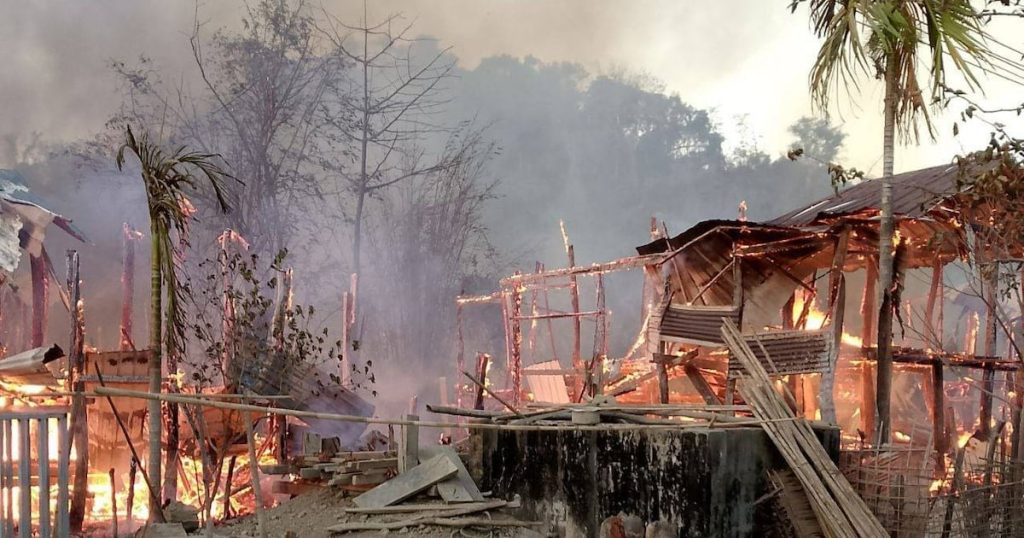
Myanmar’s military recently bombed U Gin village in Rakhine state, situated within a key economic zone that is crucial for Chinese investment. This act resulted in a fire that engulfed nearly 200 homes, highlighting the ongoing conflict between the military junta and the Arakan Army (AA), a powerful ethnic insurgent group. The AA has gained significant ground in its fight against the junta since the military coup in 2021, with the goal of seizing control over Rakhine state entirely.
Sittwe, the capital of Rakhine state, along with the Kyaukpyu economic zone, remains one of the junta’s few strongholds. This geographical area is vital due to its strategic significance for China, which has major economic interests and plans for a deep-sea port under its Belt and Road Initiative. Current fighting is focused on the Danyawaddy naval base that protects the Kyaukpyu zone, where AA fighters are intensifying their assaults.
On a specific incident reported on Thursday, the military deployed a drone to attack AA fighters in U Gin, causing a massive fire. Residents noted that the entire village was consumed by flames, although there were no casualties reported, as many had already fled due to the ongoing combat. Efforts to obtain comments from both AA and junta representatives went unanswered.
In recent developments, the AA captured three guard outposts that were responsible for defending the Danyawaddy base, compelling junta troops to retreat. This shift in control signals a potential breach in the junta’s defensive capabilities, raising concerns for China’s investment in the region. If the AA successfully captures Kyaukpyu, it could pose a significant challenge for the junta, as China may then need to engage with the insurgents directly to safeguard its economic interests, especially concerning oil and gas pipelines critical for energy transport to Yunnan province.
Meanwhile, violence persists in Sittwe, where junta forces attacked War Bo village, destroying 35 homes in the process. Residents reported heavy fighting and a deteriorating security situation as the AA continues to press forward with its campaign against the military.
The situation in Rakhine state encapsulates the broader conflict in Myanmar, with escalating tensions signaling increasing instability. The military is struggling to maintain control in the face of a determined AA, and the potential fall of key territories raises questions about the future of foreign investment and regional security, particularly regarding China’s economic foothold in Myanmar.