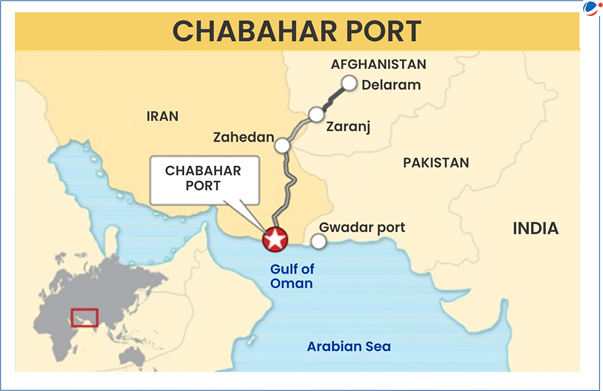
Recently, India has signed a significant 10-year agreement with Iran to develop the Shahid Beheshti Port Terminal at Chabahar Port. This agreement, finalized between India Ports Global Limited (IPGL) and Iran’s Ports and Maritime Organization (PMO), underscores India’s commitment to enhancing its trade routes and geopolitical influence. IPGL, fully owned by the Sagarmala Development Company Limited under the Ministry of Ports, Shipping and Waterways, is set to operate this strategic port, which is pivotal for facilitating trade between India, Afghanistan, and Central Asian nations while circumventing Pakistan.
The backdrop of this agreement lies in a trilateral agreement signed in 2016 between India, Iran, and Afghanistan, aimed at developing Chabahar Port. This strategic port is designed to significantly reduce the distance from India’s western coast to Afghanistan and Central Asia, thereby providing a vital link for sea routes.
In addition to the Chabahar project, the Ministry of External Affairs (MEA) has also approved IPGL’s takeover of operations at Myanmar’s Sittwe port, part of the Kaladan Multimodal Transit Transport Project. This initiative is intended to create a seamless transportation route from India’s eastern ports to Myanmar and eventually to India’s northeastern states, reducing reliance on the congested Siliguri Corridor, which is critical for regional connectivity.
The geopolitical significance of ports is increasingly recognized, as they serve as strategic assets enhancing national maritime security and control over crucial sea routes. For instance, India’s presence at Agalega Islands equips the Indian Navy to monitor the strategically important Mozambique Channel, highlighting the role of maritime security in influencing trade and national interests.
Furthermore, these developments present opportunities for strengthening bilateral and multilateral ties through strategic partnerships. For instance, India’s access to Duqm Port in Oman facilitates its engagement with Gulf nations, while access to Chabahar port allows India to forge economic partnerships in Central Asia and counter China’s influence in the region.
However, the strategic use of ports is not without challenges. The rivalry between nations, particularly between China and India, leads to competitive developments such as China’s “String of Pearls” and India’s “Necklace of Diamonds” strategies. There are also concerns regarding sovereignty, as the ownership of strategic ports can diminish long-term national interests. Additionally, security challenges such as piracy and geopolitical tensions can disrupt transportation channels critical to global trade.
For India, smaller neighboring nations perceive themselves as pawns in this geopolitical rivalry, complicating New Delhi’s influence in the region. Financial constraints further limit India’s capacity to expand its geopolitical reach through overseas port development.
To address these challenges, India must explore multilateral partnerships, particularly with nations that share similar interests, such as the QUAD countries. Strengthening India’s maritime presence in the Western Indian Ocean is essential, especially given China’s geographical disadvantages.
In conclusion, as ports serve as vital conduits for global trade and strategic influence, their effective management is crucial in navigating the current geopolitical landscape. The development of Chabahar and Sittwe ports exemplifies India’s strategic foresight in positioning itself as a significant player in regional and global maritime affairs.
Source link