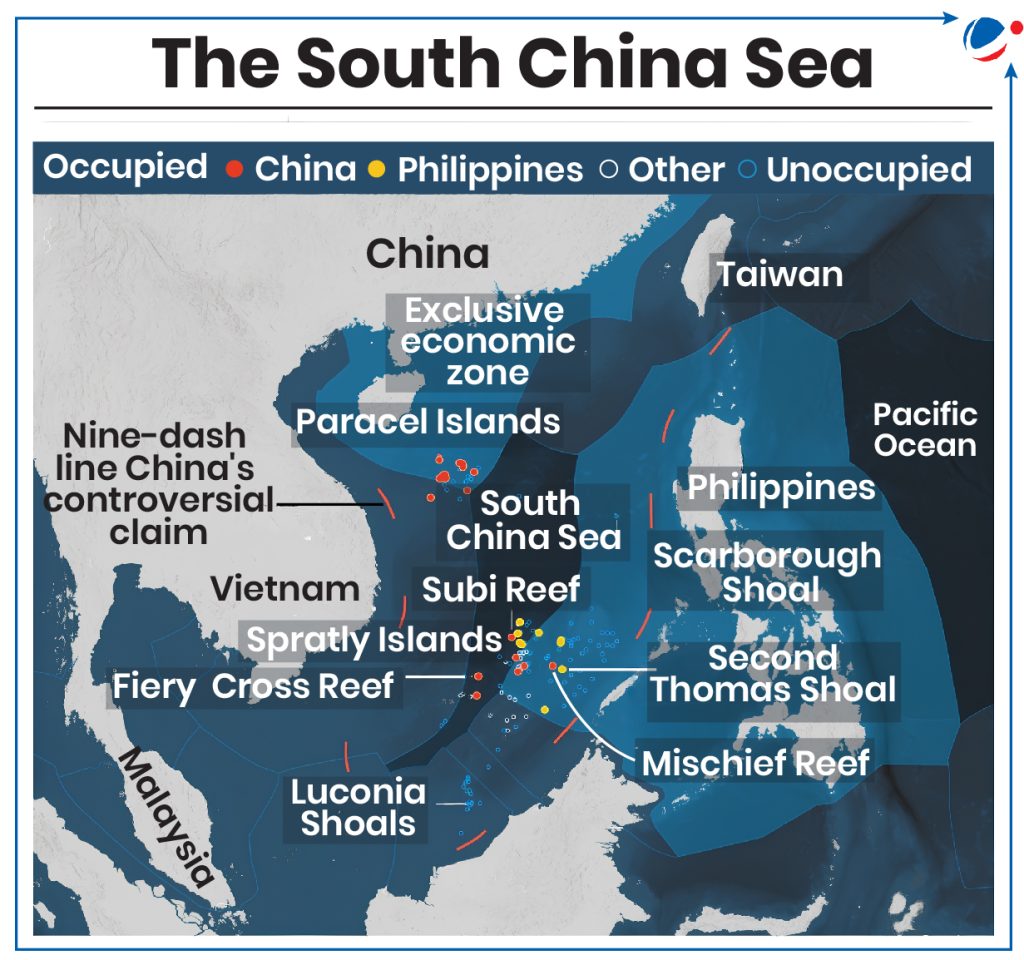
Reports of aggressive actions by Chinese vessels in the South China Sea (SCS) have notably increased over the past 17 months. Recently, China has demanded Malaysia to cease activities in an oil-rich sector near Sarawak, despite the area being close to Malaysian waters and far from China’s mainland.
Overview of the South China Sea
The SCS is an arm of the western Pacific Ocean, located south of China, east and south of Vietnam, west of the Philippines, and north of Borneo. It encompasses more than 200 small islands, rocks, and reefs, mostly uninhabitable. The region is critical not only for its geographical attributes but also for its immense economic importance.
Historical Context and Conflict
China claims virtually the entire SCS based on historical rights dating back to the Western Han dynasty. In contrast, a 2016 ruling from the Permanent Court of Arbitration favored the Philippines, declaring China’s “nine-dash line” invalid. This ruling, however, did not halt China’s assertiveness; between 2013 and 2015, it constructed artificial islands and militarized several locations in the Spratly Islands.
Importance for Global Trade
The SCS is a vital trade route, through which about one-third of global maritime trade passes annually, including 40% of globally traded petroleum products. The area holds vast hydrocarbon resources, with estimates of 3.6 billion barrels of oil and significant natural gas reserves. Additionally, its fisheries contribute around $100 billion yearly to the economy, accounting for approximately 12% of global fish catches.
Factors Driving the Conflict
- Territorial Disputes: China’s increasing territorial claims have led to heightened tensions with neighboring Southeast Asian countries.
- Resource Competition: The search for valuable resources, including rare-earth minerals and hydrocarbons, has intensified conflict.
- Nationalism: Growing nationalist sentiments in claimant countries have influenced territorial claims, with nations like China and Vietnam utilizing nationalist rhetoric.
- Strategic Interests: The SCS is not only a crucial maritime passage but also connects significant regions globally, affecting trade routes between East Asia, Europe, and India.
Potential Threats to Global Trade
The aggressive stance of China poses several risks to global trade. Recent aggressive military actions, including clashes with Filipino vessels, raise concerns of a full-blown conflict. The U.S. has warned it would defend the Philippines if attacked in the SCS, further complicating the geopolitical landscape. Moreover, China’s potential military action over Taiwan could disrupt trade routes, particularly through the Malacca Strait, exacerbating existing security issues and possibly leading to increased shipping costs and delays, presenting a third crisis in global shipping alongside the Red Sea and Strait of Hormuz.
India’s Role and Interests
India has sought to enhance its presence in the SCS through its Look East Policy, focusing on strategic partnerships with Southeast Asian nations, despite China’s disapproval. For India, the SCS is crucial for continued trade and energy security, given that a significant portion of its maritime trade passes through the region. Joint projects like offshore energy collaborations and naval exercises with ASEAN nations illustrate India’s strategic commitments.
Path Forward
To resolve the SCS disputes, diplomatic engagement and confidence-building measures are essential. Encouraging transparent communication and adhering to international laws, including the United Nations Convention on the Law of the Sea (UNCLOS), will be necessary. Strengthening regional organizations can also facilitate peaceful arbitration of conflicts, fostering cooperation among all parties involved.