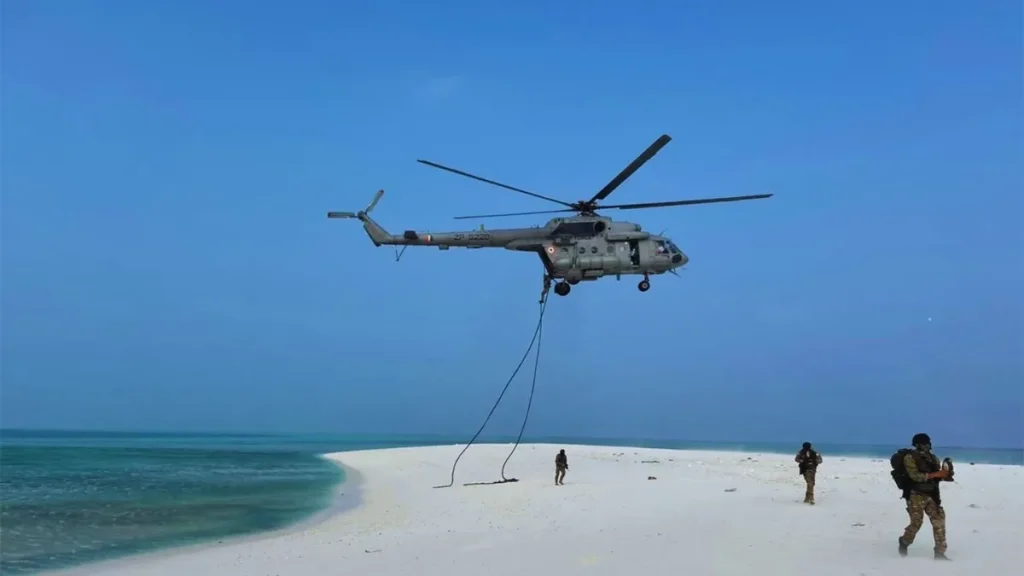
The Indian Air Force’s Southern Air Command (SAC) recently conducted a high-intensity joint maritime exercise named “Kalari Leap” in the strategically significant Lakshadweep and Minicoy archipelago. This initiative emphasizes India’s resolve to secure its island territories while fostering interoperability among various branches of its security forces.
As regional maritime dynamics change, the SAC’s focus has shifted to safeguarding the island domains of Lakshadweep and Minicoy. The Kalari Leap exercise not only showcases India’s military capabilities but also reflects its commitment to “jointmanship,” the seamless collaboration between different military units. The exercise is aptly named after Kalaripayattu, an ancient martial art from Kerala, symbolizing agility and precision essential for modern island warfare.
Key Highlights and Operations
Kalari Leap involved a series of rapid, back-to-back operations simulating real-world conflict scenarios, demonstrating multi-domain air operations:
-
Multi-Domain Air Operations:
- The exercise featured a versatile fleet designed to handle diverse operational needs.
- Su-30MKI fighters were employed for air superiority and maritime strikes.
- AN-32 and Mi-17V5 aircraft enabled quick insertion of troops and equipment to remote islands.
- The Dornier 228 served as an aerial surveillance asset for search and rescue (SAR) missions, coordinating with fighter jets during maritime strikes.
-
Special Operations and Amphibious Assaults:
- The Armed Forces Special Operations Division (AFSOD) carried out critical missions such as:
- Combat Free Fall (CFF), involving high-altitude parachute jumps for elite troops behind enemy lines.
- Special Heliborne Missions, which facilitated rapid deployment in challenging terrains.
- Amphibious Assaults, coordinated with Coast Guard Gemini boats for beach landings.
- The Armed Forces Special Operations Division (AFSOD) carried out critical missions such as:
-
Maritime Security and SAR:
- The Indian Coast Guard (ICG) played a vital role by deploying naval vessels and specialized boats to conduct anti-ship operations and practice search and rescue efforts.
Strategic Significance of Lakshadweep
The strategic importance of the Lakshadweep and Minicoy islands lies in their proximity to major international shipping routes. The exercise’s objectives included:
- Protecting Sovereignty: Maintaining readiness to respond swiftly to any threats in the Arabian Sea.
- Rapid Force Projection: Demonstrating India’s capacity to mobilize significant military power to distant outposts within hours.
- Enhancing Jointness: Improving communication and tactics between the IAF and the Coast Guard.
Context of Broader Military Activity
Kalari Leap was part of a broader surge in Indian military exercises early in 2026, which included:
- Exercise Vayushakti-26: A major firepower demonstration at Pokhran.
- Exercise Agni Varsha: An Army drill focused on long-range precision operations in desert regions.
- Exercise Vajra Prahar: A joint special forces drill involving collaboration with U.S. forces in Himachal Pradesh.
In summary, the Kalari Leap exercise reflects India’s commitment to enhancing its military readiness in strategically vital island territories while promoting cohesion among its armed forces.
Original publication date: [original_date]